7 Best AI Voice Agents for Law Firms in 2026

- Start with the call workflow you want to remove, since intake, reception, lead follow-up, active-client calls, provider outreach, and records follow-up each need a different level of automation.
- An AI receptionist mostly owns inbound answering, intake, scheduling, and routing, while a broader AI voice agent can also place outbound calls, retry open tasks, and write outcomes into connected systems.
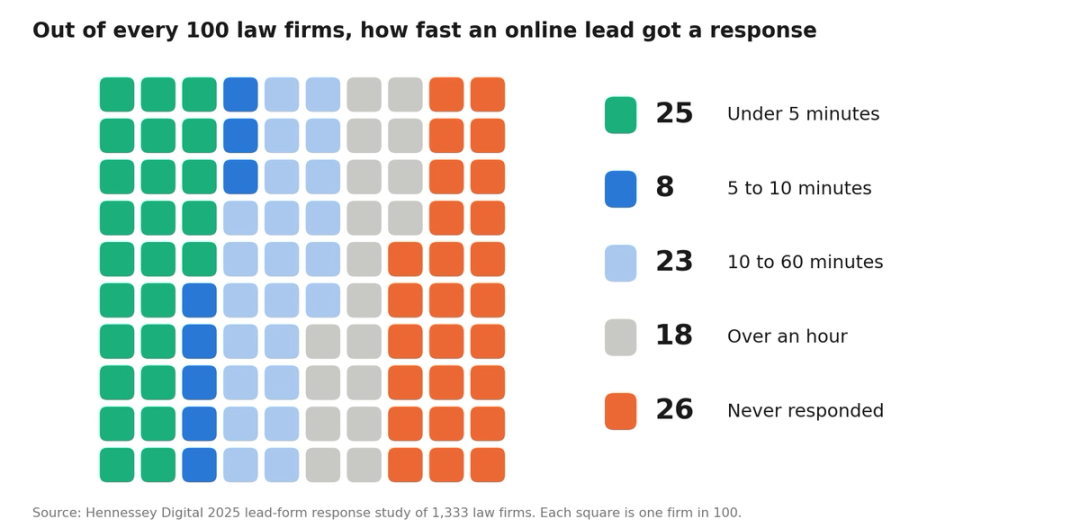
- The phone gap is still wide: only 40% of law firms answered a prospective client's call in Clio's 2024 secret-shopper study, and 26% never responded to an online lead in a 2025 study of 1,333 firms.
- HelloCounsel covers both sides of plaintiff phone work, answering inbound calls in under two rings and running outbound records, case opening, and check-in calls, starting at $500 a month with no per-minute billing.
- Test failure conditions before you buy, including failed transfers, unusual callers, repeated attempts, legal questions, missing information, and calls the AI should escalate.
AI voice agents for law firms now cover far more than after-hours message taking. Some products remain centered on reception and new-client intake, while others qualify prospects, call leads back, contact providers, monitor treatment, and update connected systems.
A general-practice firm trying to keep prospects out of voicemail needs something different from a personal injury firm whose case managers spend hours on provider, treatment, client, and records calls.
Below, we compare seven AI voice agents for law firms on inbound reception, outbound depth, case-system behavior, escalation, and pricing. Every vendor detail was checked against the vendor's own site in September 2026.
Which AI Voice Agent Fits Each Call Workflow?
The fastest way to narrow AI voice agents for law firms is to decide which part of the phone operation the product should own.
| Product | Best for | Primary scope | Outbound |
|---|---|---|---|
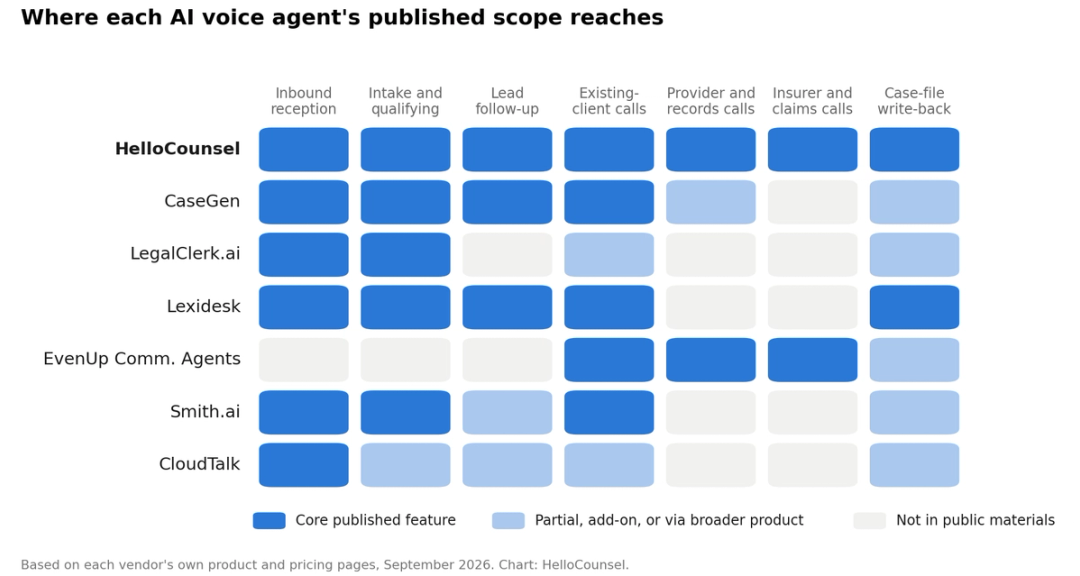
| HelloCounsel | Inbound reception + outbound PI case follow-up | Plaintiff reception, case opening, records follow-up, client check-ins, and CMS write-back | Yes |
| CaseGen | Intake + treatment follow-up | Reception, qualification, lead follow-up, existing-client calls, and treatment check-ins | Yes |
| LegalClerk.ai | Legal-focused AI reception | Reception, intake, scheduling, and routing | Primarily inbound |
| Lexidesk | Intake + CRM-triggered follow-up | Reception, intake, routing, scheduling, and outbound workflow calls | Yes |
| EvenUp Communication Agents | Existing EvenUp users | Claims, coverage, treatment, records, and balance workflows | Yes |
| Smith.ai | AI reception + human fallback | Qualification, scheduling, routing, integrations, and escalation | Selected workflows |
| CloudTalk | Phone system + AI reception | Telephony, routing, reception, and AI Specialist workflows | Via the broader product set |
Why Are Law Firms Adding AI Voice Agents in 2026?
Law firms are adding AI voice agents because too many calls and leads still go unanswered.
In Clio's 2024 secret-shopper study of 500 law firms, only 40% answered the phone when a prospective client called, down from 56% in 2019. Another 48% were essentially unreachable by phone, and 73% of shoppers said they were unlikely to recommend a firm after trying to reach it.
Online leads fare no better. In Hennessey Digital's 2025 lead-form study of 1,333 law firms, only a quarter responded within five minutes, and more than one in four never responded at all.
Responsiveness also decides who gets hired. In Martindale-Avvo's 2026 State of the Legal Consumer report, 47.6% of consumers named responsiveness as a key criterion when choosing a lawyer.
For PI firms, a signed case keeps generating client, provider, adjuster, lien, and records calls, so outbound depth matters as much as answer speed.
What Does an AI Voice Agent for a Law Firm Actually Do?
A law firm AI voice agent handles spoken phone conversations and takes defined actions based on what happens during the call. The scope varies by product.
An AI receptionist for law firms typically concentrates on the front desk: answering inbound calls, identifying the caller, collecting information, qualifying prospective clients, scheduling consultations, transferring calls, and producing summaries.
A broader legal AI voice agent may also initiate outbound calls, retry open tasks, work from matter context, update the firm's systems, and continue a defined workflow after the first conversation. In a larger legal platform, voice may be one module beside demands, case preparation, or medical records.
| Capability | AI receptionist | Broader voice agent |
|---|---|---|
| Inbound answering | Yes | Yes |
| Lead qualification | Usually | Usually |
| Appointment scheduling | Often | Often |
| Caller routing | Usually | Usually |
| Outbound calls | Limited or product dependent | Often |
| Active-case workflows | Limited | Product dependent |
| Repeated follow-up attempts | Product dependent | Often supported |
| Matter context | Product dependent | Can extend deeper into the workflow |
| Case-system updates | Often summary or integration dependent | Can include structured write-back |
| Human escalation | Product dependent | Product dependent |
The real test is what happens after the call. If the AI emails your case manager a message and the case manager still has to find the matter, call back, document the result, and create the next task, the work has not moved.
Our breakdown of how many calls a PI case can generate shows how that workload builds across the case lifecycle.
Our piece on why a generic AI receptionist can miss PI context explains why intake automation does not carry over to active cases.
If you are still deciding between voice AI and staffed reception, our comparison of AI receptionists vs. virtual receptionists for PI firms is a better place to start.
The 7 Best AI Voice Agents for Law Firms in 2026
Each AI voice agent below is judged on scope, outbound depth, case-system fit, pricing, and limits.
1. HelloCounsel covers inbound reception and outbound PI case follow-up
HelloCounsel provides AI voice agents built for plaintiff law firms. Agents answer in under two rings, match the caller ID to the case file before they pick up, and cover the mainline during office hours, overflow, and after hours.
PI phone work does not stop at signing, so HelloCounsel also runs outbound calls on active cases to providers, insurers, records departments, and clients.
Key features:
- Reception and Qualification: Agents pick up fast, recognize existing clients, providers, and adjusters against your case files, qualify intake calls against your criteria, and warm-transfer the calls that need a person. See how AI intake works.
- Case opening: Once the fee agreement lands, the agent opens the file, gets the claim number from the adjuster, and collects missing documents such as insurance cards and IDs. See automated case opening.
- Medical records retrieval and organizing: Agents submit and re-submit requests, work IVR phone trees, follow up by phone, email, and fax, log every update in your CMS, and task the right person when an invoice is due. See medical records retrieval.
- Lead follow-up and Client Check-ins: Outbound calls follow up with leads and check in with clients after appointments, with check-ins twice as frequent. See client communication.
- Case management: Insurance claim opening, hold time, redials, and task completion keep each case moving inside your CMS.
- CMS write-back: Notes are captured while the call happens and written into the case file through direct integrations with SmartAdvocate, Filevine, Litify, and Lead Docket, plus custom integrations for other systems.
- Human escalation: Calls involving judgment, exceptions, sensitive issues, or unsupported requests move to staff according to the firm's rules.
When a provider calls about an open records request, HelloCounsel identifies the caller, pulls matter context, and writes the outcome to the case file during the call, so nobody relays a message. See what CMS write-back means for a PI firm.
Proof points: Across deployments, HelloCounsel has handled 30,000+ calls and 500+ hours of call time, with 93% SOP precision and a 48% improvement in call reception rates. On records, HelloCounsel has cut turnaround time by 15 days, and the records agent costs a quarter of what retrieval companies charge.
"We've been extremely impressed with our new AI receptionist, Kate, and the impact it's already making for our firm," says Anthony Ramos, COO of Pendergast Law.
Pricing: From $500 a month, fixed to expected volume with 20% tolerance either way. There is no per-minute billing and no setup fee, and firms can bill usage by case as an itemized pass-through expense.
Onboarding: One 1-hour call with 17 multiple-choice questions captures your SOPs, and agents go live in SmartAdvocate in about a week. SmartAdvocate firms focused on new-client calls can compare options in our guide to AI intake assistants for Smart Advocate firms.
Why choose HelloCounsel: Choose it when your firm needs calls answered around the clock and case managers are losing hours to repetitive records, provider, treatment, or client follow-up calls.
Where it falls short: HelloCounsel is built for plaintiff firms that run a production case management system, and it works inside that system rather than replacing it. It does not draft demands, value cases, or give legal advice, so a firm with little post-intake phone work may only need an AI receptionist.
2. CaseGen pairs intake with treatment follow-up
CaseGen is an AI legal receptionist and intake platform built for law firms. Its product combines 24/7 reception, prospect qualification, persistent lead follow-up, existing-client call handling, and treatment coordination through three named agents. For a head-to-head view, see HelloCounsel vs CaseGen.
Key features:
- 24/7 legal reception: CaseGen answers inbound calls during office hours, after hours, and weekends, and blocks unwanted calls.
- Full intake: Its intake agent gathers case details and qualifies prospective clients with structured questions.
- Persistent lead follow-up: An outreach agent follows up with prospects who have not signed and completes their intakes.
- Live transfer alerts: High-value leads are flagged in real time so staff can take a live transfer.
- Treatment follow-up: A medical coordinator agent checks in with providers and clients about treatment status.
- Integrations and analytics: Connections include Clio, Filevine, Lawmatics, 8am, and Zapier, alongside transcripts, call summaries, and call-volume tracking.
Pricing: CaseGen does not publish pricing. Confirm call allowances, outbound activity, medical coordination, integrations, and any higher-volume terms directly.
Why choose CaseGen: It makes sense when intake conversion is still the main problem but your firm also wants selected post-intake calls handled, particularly treatment follow-up.
Where it falls short: CaseGen's public materials center on intake, prospect outreach, current-client calls, and treatment coordination. Firms that need medical-record retrieval, insurer workflows, or structured case-file write-back should ask CaseGen to demonstrate those exact workflows.
Weighing other options? See our guide to CaseGen.ai alternatives.
3. LegalClerk.ai is a legal-focused AI front desk
LegalClerk.ai is a law firm AI receptionist focused on 24/7 answering, legal intake, lead qualification, appointment scheduling, transfers, multilingual support, and call logs. It is built around legal reception rather than adapting a general small-business answering product.
Key features:
- 24/7 call answering: Calls are covered during nights, weekends, holidays, and business hours, with overflow handling at peak times.
- Legal intake and qualification: The AI follows the firm's intake flow, with practice-specific intake for personal injury, family law, criminal defense, immigration, and other areas.
- Appointment scheduling: Consultations can be booked from the call and synced with existing calendars.
- Transfers and escalation: Priority calls can be transferred based on firm rules.
- Integrations: Connections include Clio, MyCase, Google Calendar, and Calendly.
- Custom scripts: Firms can configure greetings, intake questions, and routing logic.
Pricing: LegalClerk offers a 7-day free trial, then an Unlimited Calls plan at $400 per seat a month. An Enterprise plan with multi-location management and live-agent escalation is custom priced.
Why choose LegalClerk.ai: It is a strong candidate when you want a legal-aware AI front desk that answers, screens, schedules, and routes calls consistently without staffing every hour.
Where it falls short: The public product story is still reception and intake. A PI firm looking for medical-record chasing, provider follow-up, insurer work, or repeated active-case outbound calls should validate those tasks separately.
4. Lexidesk adds CRM-triggered follow-up to legal intake
Lexidesk combines 24/7 legal reception and intake with outbound calling, including CRM-triggered calls such as a reminder when documents are still missing a week after a request. It sits between a reception-only AI product and a plaintiff case-operations agent.
Key features:
- 24/7 reception: Handles new leads, existing clients, third parties, and after-hours calls.
- Caller-type-aware routing: Different callers follow different flows rather than one generic script.
- Legal intake and scheduling: Prospects are qualified against firm-defined criteria and can move straight into a consultation.
- Warm transfers: Calls reach the right attorney, department, or team.
- Flexible CRM mapping: Intake data can be written into specific fields and pipelines.
- Website callbacks: Visitors can request an immediate call or pick a time.
- Batch calling: Firms can upload lists, and the system retries on a set cadence inside the hours the firm chooses.
- CRM-triggered calls: A CRM step can place a call, with the outcome returned to the CRM.
Pricing: Lexidesk does not publish a rate card. Confirm inbound volume, outbound usage, CRM connections, setup, and whether workflow calls require a different plan.
Why choose Lexidesk: It fits consumer-facing firms that want intake automation plus a wider range of outbound lead and workflow-triggered calling.
Where it falls short: PI firms should still test plaintiff-specific post-signature work. A CRM-triggered document reminder and repeated medical-record or provider follow-up are operationally different jobs.
5. EvenUp Communication Agents suit firms already using EvenUp
EvenUp Communication Agents add voice and text outreach to EvenUp's plaintiff AI platform. Unlike an intake-only AI receptionist, the agents work on cases that are already signed.
Key features:
- Claims opening: Agents contact carriers to open claims and retrieve claim numbers and adjuster assignments.
- Liability and coverage: Agents call carriers to confirm coverage.
- Treatment monitoring: Voice and text check-ins track client appointments and flag issues for staff.
- Medical records follow-up: Agents follow up with providers about outstanding records.
- Medical balance verification: Agents retrieve provider bills and confirm balances.
- Voice, SMS, and two languages: Agents work in English and Spanish, and send summaries, transcripts, and recordings by email.
- Broader PI platform: Voice sits alongside EvenUp's demand and case-preparation products.
Pricing: EvenUp describes all-in-one, case-based pricing and does not publish rates for Communication Agents. Our breakdown of EvenUp pricing covers what to ask about the wider relationship.
Why choose EvenUp Communication Agents: Consolidation is the strongest reason. If your firm already uses EvenUp for demands and case preparation, adding communications on the same platform reduces the number of vendors your team manages.
Where it falls short: EvenUp's agents are built for outbound case work rather than answering your mainline, so firms that also need inbound reception will likely need a second product.
A firm searching broadly for legal AI rather than voice automation may prefer our comparison of AI tools for personal injury lawyers, which separates call operations from drafting, case preparation, and intake.
Did You Know
According to Clio's 2025 Legal Trends Report, 79% of legal professionals now use AI in their firms. In a voice demo, ask how much of the workflow the AI actually finishes.
6. Smith.ai pairs AI reception with human escalation
Smith.ai offers a multi-industry AI Receptionist, backed by a network of 500+ North America-based receptionists when a call needs a person. That human fallback is its clearest differentiator. If you'd rather keep a human answering service on the phones, compare these legal answering services for PI firms.
Key features:
- 24/7 AI answering: Incoming calls are handled at any hour.
- Lead qualification and routing: The AI asks firm-defined questions and moves calls to the right destination.
- Scheduling: Appointments can be booked through supported scheduling integrations.
- Recordings and transcripts: Every interaction is recorded, transcribed, and summarized.
- Legal integrations: Native integrations include Clio Grow and Clio Manage, with thousands more through Zapier and Make.
- Live data: Higher tiers can pull case status and hearing dates from a connected case system during the call.
- Human escalation: AI-initiated escalation carries no fee, and live-agent involvement is a per-call add-on.
Pricing: Smith.ai lists a Free plan at $0 a month for 25 calls, then $3 a call. Pro starts at $150 a month for 75 calls, and Enterprise starts at $500 a month for 300 calls, with larger call bundles in each paid tier.
Why choose Smith.ai: Choose it when you want an established AI receptionist with a clear human fallback and public pricing you can model before a sales call.
Where it falls short: Smith.ai is a horizontal communications provider rather than a plaintiff operations product. PI firms should test the provider, treatment, records, and existing-client workflows they need directly.
7. CloudTalk suits firms replacing the phone system and adding AI
CloudTalk approaches voice AI from the telephony side, pairing business calling with AI Receptionist and AI Specialist products. That makes it a different purchase from adding a plaintiff-specific voice agent to your current phone system.
Key features:
- AI Receptionist: Handles inbound calls, answers FAQs from your own content, takes messages, and books meetings.
- 24/7 coverage: Built for front-desk, overflow, and after-hours use.
- 70+ languages: The receptionist detects the caller's language automatically.
- Business telephony: Calling infrastructure sits in the same product family.
- Conversational routing: Routing can replace traditional phone trees.
- CRM sync: Call details sync to CRMs such as HubSpot, Salesforce, and Pipedrive.
- AI Specialist: Higher-level agents perform multi-step workflows and make system updates.
Pricing: CloudTalk's AI Voice Agent pricing starts at $99 a month for 200 minutes, with 50 free minutes in the first month. The AI Specialist plan is $349 a month for 1,000 minutes, and phone plans are priced separately.
Why choose CloudTalk: It makes sense when the phone system itself is part of the replacement project. A firm can evaluate telephony, routing, analytics, and AI under one vendor.
Where it falls short: CloudTalk is a horizontal platform, and its listed CRM connections are general business tools rather than legal case systems. A plaintiff firm should test how matter context reaches the agent and exactly how call outcomes reach the case file.
What Do AI Voice Agents for Law Firms Cost?
AI voice agents for law firms are priced in four ways: per call, per minute, per seat, or as a fixed monthly amount. The meter matters as much as the starting price, because it decides what a busy month costs.
| Product | Published starting price | Meter | What to confirm |
|---|---|---|---|
| HelloCounsel | From $500 a month | Fixed monthly amount set by volume | 20% tolerance either way, no per-minute billing, no setup fee |
| CaseGen | Not published | Quoted | Outbound activity and medical coordination scope |
| LegalClerk.ai | $400 per seat a month | Per seat, unlimited calls | 7-day free trial; Enterprise is custom priced |
| Lexidesk | Not published | Quoted | Outbound and CRM-triggered call usage |
| EvenUp Communication Agents | Not published | Case-based | Pricing within the wider EvenUp relationship |
| Smith.ai | $0 for 25 calls; $150 for 75 calls; $500 for 300 calls | Per call | Human agents cost extra per call |
| CloudTalk | $99 for 200 minutes a month | Per minute | AI Specialist is $349 for 1,000 minutes; phone plans extra |
Per-call and per-minute meters rise with every volume spike, and outbound records and check-in calls burn minutes fast. Model a full month of inbound and outbound calls before comparing plans, using our guide to AI receptionist pricing.
Practical Tip
The U.S. Bureau of Labor Statistics puts the May 2025 median receptionist wage at $18.27 an hour, or $38,010 a year. Use it as a benchmark for one employee, then add payroll burden, after-hours gaps, and supervision before comparing software costs.
How to Choose an AI Voice Agent for Your Law Firm
The right AI voice agent depends on the work you want handled, not on which demo voice sounds most human. Start by separating front-door coverage from active-case phone work.
| If your firm... | Prioritize... |
|---|---|
| Misses prospective clients during office hours or after hours | 24/7 answering, intake, qualification, scheduling, and routing |
| Wants AI but still needs a person for selected calls | Defined live-human escalation |
| Needs legal-focused front-desk automation | Legal intake, caller routing, scheduling, and integrations |
| Needs prospect follow-up after initial contact | Persistent lead follow-up and CRM-triggered calls |
| Already uses a broader PI AI platform | Whether its native voice module covers the workflows you actually need |
| Has case managers buried in repeat calls | Outbound workflows, retries, matter context, escalation, and case-file write-back |
| Is replacing the phone system too | Telephony and AI in the same architecture |
If your only problem is missed new-client calls, a specialized AI receptionist for law firms may be enough. If the problem continues after the client signs, separate records calls, treatment communication, provider follow-up, client updates, insurer work, and other repeatable case tasks.
The hidden cost of missed calls at a PI firm is useful when unanswered and repeated inbound traffic is the constraint.
If the heavier problem sits with existing cases, our guide to reducing case-manager workload helps identify which administrative phone workflows are consuming staff time without needing case-manager judgment.
Pressure-Test Every AI Voice Agent With the Same Calls
Marketing demos tend to show ideal conversations, so your buying process should test the cases where automation usually breaks. Our guide to evaluating an AI voice agent explains the criteria behind each of these tests.
- Run a real inbound call: Use one prospective client and one existing client, and confirm the agent sends them down different paths.
- Run a real outbound task: If the product claims outbound capabilities, use a workflow your staff performs today rather than the vendor's sample.
- Miss the first attempt: Find out whether the workflow retries automatically, waits for another trigger, creates a task, or simply stops.
- Create an exception: Ask a legal question or leave out required information, since the agent should know when the issue belongs with a human.
- Force a transfer failure: See what happens when the intended employee does not answer.
- Inspect the system of record: Identify the exact note, field, task, transcript, or status created.
- Count staff touches: Write down everything your team still has to do after the agent says the workflow is complete.
- Test office hours and after hours: A product may behave differently when staff are unavailable, so use both conditions.
Weight the case-system test most, since a summary in a separate dashboard still leaves documentation to the case manager. Our piece on answering services and PI documentation covers that gap.
Add Governance to the Voice-Agent Evaluation
A voice agent speaks to clients, providers, and insurers on the firm's behalf, so governance belongs in the evaluation alongside workflow design.
ABA Formal Opinion 512, issued in July 2024, discusses lawyers' duties of competence, confidentiality, communication, supervision, and reasonable fees when using generative AI.
The NIST Generative AI Profile provides a useful framework for testing expected behavior, monitoring, human oversight, and failure handling.
If protected health information could move through a workflow, HHS guidance on business associates can help your firm and counsel determine which parties, agreements, and safeguards apply.
Outbound calls add one more layer. In a February 2024 declaratory ruling, the FCC confirmed that AI-generated voices count as "artificial" voices under the TCPA, so those calls need the called party's prior express consent unless an exemption applies.
None of these sources certifies a vendor as compliant, but they shape the questions to ask. At minimum, establish:
- What information the AI can access.
- Where recordings, transcripts, summaries, and notes are stored.
- Who can access them.
- What happens when the AI does not know the answer.
- Which workflows require human review.
- How transfers and escalations are handled.
- How the firm monitors failures.
- What consent and recording rules apply in the jurisdictions involved.
Measure Work Removed, Not Calls Answered
Answer rate is the easiest metric and the least complete, since a product can answer every call and still send the work back to your staff.
Use operational measures that reveal what changed after implementation.
| Metric | What it actually tells you |
|---|---|
| Answer rate | Whether incoming calls are being picked up |
| Transfer rate | How much inbound work still reaches staff |
| Callback volume | Whether handling the first call reduces downstream work |
| Repeat-call rate | Whether callers are getting what they need |
| Outbound completion rate | Whether defined follow-up reaches its required outcome |
| Retry volume | How often workflows require another attempt |
| Case-file documentation | Whether call information reaches the operational system of record |
| Staff touches per workflow | How many employee steps remain after automation |
| Escalation quality | Whether exceptions reach the appropriate person with useful context |
A shorter call is not automatically better either. If one AI finishes a four-minute conversation but creates three manual tasks, while another takes six minutes and closes the workflow, average handle time would favor the wrong product.
Call count also hides the difference between a two-minute status question and 25 minutes in a provider phone tree, so measure the process rather than the phone activity.
Choose the AI Voice Agent That Removes the Right Work
The best AI voice agents for law firms do not all solve the same problem. LegalClerk.ai suits a firm that mainly needs an AI front desk, Smith.ai adds a clear human fallback, and Lexidesk pairs consumer-facing intake with flexible outbound triggers.
CloudTalk is stronger when phone infrastructure is part of the project, CaseGen extends intake into treatment follow-up, and EvenUp gives existing platform users a wider set of PI communication workflows.
For a plaintiff firm, HelloCounsel fits when the problem spans both sides of the phone operation: inbound reception around the clock, plus outbound work on active matters.
Start by mapping one recurring call workflow: what happens on the first call, what happens when nobody answers, and what should land in the case file. Then see how HelloCounsel works.
See HelloCounsel on your actual workflow
Bring one call process your team handles today. We'll show you where the agent fits, what gets completed, and what still goes to a person. Book a demo
Frequently Asked Questions
These are the questions firms ask most often when comparing AI voice agents for law firms.
1. What are the best AI voice agents for law firms?
Strong options include HelloCounsel, CaseGen, LegalClerk.ai, Lexidesk, EvenUp Communication Agents, Smith.ai, and CloudTalk. The right choice depends on whether you need reception, intake, human escalation, outbound case workflows, broader legal AI, or telephony.
2. What is the difference between an AI voice agent and an AI receptionist?
An AI receptionist mainly handles inbound answering, intake, scheduling, and routing. A broader AI voice agent may also place outbound calls, retry supported tasks, use matter context, document outcomes, and update connected systems.
3. Can AI voice agents for law firms make outbound calls?
Some can, with scope ranging from lead callbacks to treatment, records, provider, and insurer calls. Ask the vendor to show your exact task, retry logic, escalation path, system update, and how it records consent for outbound calls.
4. Can an AI voice agent replace a law firm receptionist?
It can automate many routine reception tasks, including answering, screening, scheduling, and routing. Firms still need people for judgment, legal questions, sensitive conversations, exceptions, and calls outside the agent's defined workflow.
5. Do AI voice agents integrate with legal case management software?
Many advertise integrations, but depth varies. Confirm what the agent can read, what it writes after the call, which matter receives the update, and whether staff still have to classify or re-enter anything.
6. How does HelloCounsel work with our case management system?
HelloCounsel sits beside your case management system and writes every call outcome into the case file. Direct integrations cover SmartAdvocate, Litify, Filevine, and Lead Docket, with custom integrations built for other systems.
Share this article