8 Best Legal Answering Services for Personal Injury Firms in 2026

- Start with the call problem. A firm trying to capture more new cases needs a different service from one trying to remove provider, records, treatment, and client follow-up from case managers.
- Human, AI, and hybrid models all belong in the category now. Compare them by the work completed, escalation path, and system handoff rather than by whether a person or AI answers first.
- Legal intake depth still matters. Answering Legal, LEX Reception, Alert Communications, Blazeo, and Go Answer bring all legal-specific intake that a general receptionist may need more configuration to match.
- Pricing models behave differently when calls run long. At 300 calls a month, doubling the average call from four to eight minutes doubles a $2.50-per-minute bill, while per-call plans stay flat.
- HelloCounsel ranks first for the PI call-operations lens used here, with custom pricing based on call and case volume rather than seats or minutes. Firms that want live human reception may prefer Answering Legal, LEX Reception, Alert Communications, Ruby, or Go Answer.
Personal injury (PI) firms have more answering-service choices than they did even a year ago. Legal-only human services still dominate traditional reception, while AI-first and hybrid providers increasingly handle intake, routing, scheduling, follow-up, and selected outbound work.
A legal answering service is a third-party service that answers calls for a law firm and follows the firm's rules for intake, message taking, transfers, scheduling, and other approved call tasks. For a PI firm, the useful comparison goes further: which calls the service can actually finish, how the result reaches the firm's intake or case system, and what the bill does when call volume jumps.
Below are the legal answering services a plaintiff firm is most likely to shortlist in 2026, with every price checked on the vendor's own site in October 2026.
Our Top Picks by Firm Need
The ranking uses a PI-specific lens: legal intake depth, coverage model, outbound scope, integration behavior, pricing structure, escalation, and how much staff work remains after the conversation. That produces a different order from a general small-business answering-service list.
| Service | Best for | Model | Pricing model |
|---|---|---|---|
| HelloCounsel | Inbound reception + outbound PI case follow-up | Plaintiff-focused AI voice agents | Custom, based on call and case volume; not per seat or per minute |
| Alert Communications | Mass-tort and campaign-scale intake | Legal-focused human call center | $2.50 per minute with a $100 monthly minimum |
| Answering Legal | Legal-only human reception | U.S.-based human receptionists | Per minute, quoted after a free trial |
| LEX Reception | Legal-only human intake with outbound follow-up | Human receptionists | Per minute, rounded up; plan prices gated |
| Blazeo | Omnichannel intake and retainer signing | Human, AI, chat, and voice mix | Voice plans from $249 a month |
| Smith.ai | Per-call human reception with a separate AI option | Human-first and AI-first products | Published per-call plans |
| Ruby | Premium human-first reception | Human receptionists with AI-assisted features | Published minute plans from $250 |
| Go Answer | Flexible month-to-month legal intake | Human call center | Published minute plans from $175 |
Did You Know
Hennessey Digital's 2025 lead-response study found that phone remained the most common way law firms responded to online leads, used by 87% of firms in the study. That makes phone coverage part of intake performance even when the lead starts on a form.
The 8 Best Legal Answering Services for PI Firms in 2026
The list below gives each service the same treatment: where it fits, what it handles, how pricing works, the strongest reason to choose it, and a real limitation.
1. HelloCounsel covers inbound reception and outbound case follow-up
HelloCounsel is built for plaintiff firms that want to cover inbound reception and move repetitive outbound case work off their teams. Its AI voice agents answer in under two rings, match the caller ID to the case file, and handle reception, intake, case opening, medical-record follow-up, and client check-ins.
The distinction is important because answering the phone solves only one part of a PI firm's call workload. Providers still need follow-up, treatment status still needs checking, and clients still call about active matters, so HelloCounsel is designed around the wider workflow rather than stopping once an inbound call has been answered.
Key features
- Inbound reception: Caller identification, routing, note capture, and escalation based on firm-defined rules, with status questions answered straight from the case file.
- Outbound workflows: Medical-record follow-up across phone, email, and fax, case-opening calls to carriers for claim numbers, and check-ins after every client appointment.
- Matter context: Agents use caller and case information rather than treating every caller as a new lead.
- Follow-up logic: Outbound work continues across attempts when the SOP requires another contact, and the right person is tasked when an invoice is due.
- Case-file handoff: Every call is written into the case file as a note the whole team can see. HelloCounsel integrates with SmartAdvocate, Filevine, Litify, Lead Docket, CASEpeer, MyCase, and Lawmatics, and adds new systems on request.
Proof points: HelloCounsel has handled 30,000+ calls, cut 15 days from records turnaround, and runs client check-ins twice as often. Its receptionist agent is priced at a quarter of the cost of virtual receptionists, and most firms go live in under two weeks.
Pricing: HelloCounsel pricing is custom and based on the firm's call and case volume, not on seats or minutes. Firms pay only for the tasks agents complete, so a long intake call does not cost more than a short one.
Why choose it: Choose HelloCounsel when your case managers are still doing repeatable phone work after the client signs. The workflow distinction is explained in the case for automating outbound calls at a PI law firm.
For the inbound side of the same problem, why generic AI receptionists can miss PI context shows what to test when an answering tool meets an active-matter call.
Where it falls short: HelloCounsel is designed for plaintiff firms with case managers and a production case system. It works inside the CMS rather than replacing it, and it does not draft demands, value cases, or make legal judgments.
2. Alert Communications handles campaign-scale and mass-tort intake
Alert Communications is a legal-focused human call-center and intake provider with a long history in high-volume legal campaigns. It handles live answering around the clock, legal intake, appointment booking, warm transfers, case-management integration, and retainer services, which makes it especially relevant to firms running television, digital, or mass-tort campaigns where lead volume can jump quickly.
Key features
- 24/7 call coverage: Human agents answer every call live during office hours, overflow, and after hours.
- Legal intake: Firms build qualification flows around practice area and campaign requirements using firm-approved scripts.
- Campaign capacity: Alert supports large advertising and marketing campaigns rather than only steady office overflow.
- Retainer services: Contract and retainer work is offered alongside call and intake services.
- Conflict checks and urgency routing: Real-time conflict checking and urgent-call routing are part of the intake service.
- System integration: Alert integrates directly with case management platforms such as Clio and MyCase.
Pricing: Alert's legal answering service costs $2.50 a minute, with a $100 floor each month, so cost scales with actual call volume. Retainer and campaign services are quoted separately.
Why choose it: Alert makes sense when live human intake and surge capacity matter more than having a fixed staffing footprint. It is one of the strongest options here for campaign-driven PI and mass-tort volume.
Where it falls short: Minute and retainer charges can climb when the campaign succeeds. Firms should model a normal month, a spike month, and the expected retainer volume before comparing Alert with a fixed monthly service.
3. Answering Legal is the legal-only human reception pick
Answering Legal is a legal-only, U.S.-based human receptionist service that has served law firms since 2013. Its receptionists handle 24/7 answering, legal intake, bilingual English and Spanish calls, appointment scheduling, transfers, message taking, and direct integrations with supported legal software.
The legal-only operating model is the main reason to shortlist it. A firm that wants a person on every inbound call can start with staff already trained around law-firm intake rather than adapting a general business script.
Key features
- Legal-only reception: Receptionists answer exclusively for law firms.
- Custom intake: Firms can configure intake questions and routing around their own criteria.
- 24/7 coverage: New leads and existing clients can reach a live receptionist at any hour.
- Bilingual service: English and Spanish reception is included at no extra charge.
- Direct integrations: Answering Legal lists 753 direct integrations, including SmartAdvocate, Litify, Lead Docket, Clio Grow, and MyCase.
- Free trial: A no-commitment free trial measures the firm's real call volume before a quote.
Pricing: Answering Legal bills by the minute on a flat rate and does not publish plan prices. It quotes each firm after the free trial, and intake, bilingual support, nuisance calls, and talk time after a transfer are not charged extra.
Why choose it: It is one of the clearest fits for firms that want legal-trained humans and do not want to manage a generalist call center. For the intake side of the buying decision, why PI firms lose cases before they sign explains why coverage and handoff speed deserve scrutiny.
Where it falls short: Current public materials emphasize inbound reception, intake, and lead capture. We could not verify a broad outbound calling service comparable with vendors that explicitly sell outbound calling, so post-signature needs should be tested separately.
Worth Knowing
In Clio's 2024 secret-shopper study of 500 law firms, only 40% answered the phone when a prospective client called, down from 56% in 2019. Whichever service you choose, measure it on how many calls reach a person or agent who can act on them.
4. LEX Reception pairs legal-only humans with outbound follow-up
LEX Reception is a legal-only human receptionist service covering round-the-clock answering, intake, bilingual reception, appointment scheduling, warm transfers, client support, integrations, and outbound follow-up. It sits close to Answering Legal on legal specialization but makes outbound follow-up a visible part of the service offering.
Key features
- 24/7 answering: Human receptionists cover new and existing callers around the clock.
- Legal intake: Call flows can collect the information required for the firm's practice areas.
- Warm transfers: Calls can move to staff with the context already collected.
- Outbound follow-up: LEX offers prompt follow-up for both leads and clients.
- Scheduling and live chat: Consultations are booked into attorney calendars, and website visitors can reach live chat.
- Legal integrations: LEX connects with Clio, MyCase, Filevine, Lawmatics, PracticePanther, Smokeball, and other legal tools.
Pricing: LEX bills by the minute and rounds up, so a 2-minute-28-second call counts as three minutes. Plan prices sit behind a contact form, so firms should request the rate card and overage rules before comparing it with published plans.
Why choose it: LEX is a strong option for firms that want legal-only humans but also need some outbound follow-up. That makes it broader than an inbound answering-only service without moving to a fully AI-led operating model.
Where it falls short: Rounding and per-minute overages can matter on long PI intake calls. Firms should also separate lead follow-up from active-matter provider, records, treatment, or insurer work, because "outbound" can cover very different tasks.
5. Blazeo combines omnichannel intake with retainer signing
Blazeo combines a voice call center with live chat, AI chat, Voice AI, appointment scheduling, lead management, and contract signing. It serves several industries, but its legal products are particularly relevant to contingency firms that want phone, web, SMS, and retainer workflows under one vendor.
The channel mix is why Blazeo belongs on a 2026 shortlist. A PI marketing campaign rarely produces calls alone, and Blazeo is designed to collect chat, form, SMS, and phone leads through one front-end process.
Key features
- Voice call center: U.S.-based call-center coverage supports inbound intake and outbound follow-up.
- Live and AI chat: Website visitors can be qualified without waiting for staff.
- Appointment scheduling: Qualified prospects can move directly into consultations.
- Contract signing: Blazeo supports retainer signing for contingency firms, including personal injury.
- Lead management: A central dashboard tracks leads, scheduling, and communications.
- CRM support: Voice plans include CRM integration and custom call routing.
Pricing: Blazeo's voice call-center plans start at $249 a month for 75 minutes, with overage from $3.83 a minute on the entry plan down to $1.90 on Enterprise. Voice AI also starts at $249 for 125 minutes, and live chat starts at $49.
Why choose it: Blazeo fits firms that want to consolidate several lead-capture channels and retainer work rather than buying a phone-only answering service.
Where it falls short: It is multi-industry and broader than legal reception alone. PI firms should test practice-area intake depth and confirm which system receives the completed lead, signed retainer, and follow-up status.
6. Smith.ai sells per-call human reception alongside an AI receptionist
Smith.ai offers distinct human Virtual Receptionist and AI Receptionist products, which use different labor models and pricing. The human service provides 24/7 bilingual receptionists, lead screening, intake, scheduling, transfers, payment collection, transcripts, and outbound calls, while the AI product handles qualification, routing, scheduling, summaries, and integrations with optional live-agent involvement.
Key features
- Human and AI choices: Firms can evaluate human-first and AI-first reception separately.
- Per-call human billing: Long intake calls do not consume a minute bucket the way minute-based services do.
- 24/7 bilingual reception: Human plans offer around-the-clock English and Spanish coverage.
- Lead intake and scheduling: Both product lines support front-end conversion workflows.
- No charge for spam: Spam and unsolicited sales calls that fail caller ID checks are not billed.
- Integrations: Smith.ai connects with legal and general CRM systems, with deeper custom workflows on higher AI tiers.
Pricing: Human Virtual Receptionist plans start at $300 for 30 calls, $810 for 90, and $2,100 for 300, with overage falling from $11.50 to $8.50 a call. Spanish adds $1 a call and extended intake adds $1.50, while the AI Receptionist runs from a free 25-call tier to Enterprise at $500 for 300 calls.
Our Smith.ai pricing guide breaks down the human and AI plans in more detail.
Why choose it: Smith.ai is useful when per-call billing is easier to forecast than minutes, or when the firm wants an AI option with a human escalation path from the same vendor.
Where it falls short: Smith.ai is not legal-only, and several human-service functions carry add-on charges. Compare the exact intake, Spanish, booking, and outreach configuration rather than the base plan alone.
7. Ruby delivers premium human-first reception
Ruby is a human-first virtual receptionist service with 24/7 coverage, bilingual answering, scheduling, intake, payment collection, outbound calling, AI-assisted transcripts, and phone service hosting. It serves many industries and is best known for a polished live-receptionist experience rather than legal specialization.
Key features
- 100% live reception: Calls are handled by human receptionists.
- 24/7 and bilingual coverage: Firms can extend reception beyond office hours in English and Spanish.
- Scheduling and intake: Receptionists qualify leads, collect intake details, and book appointments.
- Outbound calling: Ruby lists outbound calls among its current service features.
- AI-assisted call flows: AI supports transcription and information gathering without replacing the human-first model.
- No setup fees: Ruby charges nothing extra for activation, onboarding, setup, or customization.
Pricing: Current virtual receptionist plans are $250 for 50 minutes, $395 for 100, $720 for 200, and $1,725 for 500. Ruby does not publish overage rates, so confirm the rate for your tier with sales.
Why choose it: Ruby is a strong fit when caller experience and live human coverage are the priority, particularly for a smaller firm that wants an established receptionist service without building an internal front desk.
Where it falls short: Ruby is not legal-specific, and minute billing means complex PI intakes use more of the plan. Firms that run into those limits can compare these Ruby alternatives for PI firms.
Practical Tip
The U.S. Bureau of Labor Statistics projects about 105,100 receptionist openings each year through 2035, even as total receptionist employment declines 2%. Outsourcing is therefore partly a coverage and staffing decision rather than only a software comparison.
8. Go Answer suits firms that want month-to-month legal intake
Go Answer provides 24/7 legal intake, bilingual answering, customized call handling, message delivery, integrations, and month-to-month service. Its legal offering covers personal injury and mass tort alongside other practice areas, and its published pricing makes different call-volume bands easy to model.
If Go Answer is already on your shortlist, our guide to Go Answer alternatives covers the other options.
Key features
- 24/7 legal intake: Live agents can handle calls and chat messages at any hour.
- Custom call instructions: Firms define how calls should be answered, screened, and routed.
- Bilingual service: English and Spanish coverage is available as a per-minute add-on.
- Flexible integrations: Go Answer can connect with the firm's existing workflow and software.
- Month-to-month plans: Firms can scale the minute package without a long-term contract.
- No setup fees: Go Answer does not charge setup fees.
Pricing: Plans run from $175 for 100 minutes and $345 for 300 to $1,100 for 1,000 minutes, with larger tiers up to 10,000 minutes and overage falling from $1.75 to $1.25 a minute. Legal receptionist service adds $0.50 a minute and bilingual service adds $0.30.
Why choose it: Go Answer makes sense for firms that want a human service with published pricing and the ability to scale month to month without committing to an enterprise legal intake provider.
Where it falls short: The company serves multiple industries, so a PI firm should test the actual qualification flow, transfer rules, and case-system handoff with its own intake scenarios before treating the legal landing page as proof of workflow depth.
How to Choose a Legal Answering Service for Your PI Firm
The right service depends on the work your phones create. Start with three months of call detail and separate new leads, existing clients, providers, treatment follow-up, records, insurers, and other administrative traffic, which tells you whether your bottleneck is intake coverage, campaign scale, active-case calls, or all three.
| If your firm... | Prioritize... | Shortlist |
|---|---|---|
| Needs legal-trained humans on every inbound call | Legal intake depth, bilingual coverage, transfers, and lead integrations | Answering Legal, LEX Reception |
| Runs high-volume campaigns or mass tort | Surge capacity, scripted intake, retainer handling, predictable peak-month economics | Alert Communications, Blazeo |
| Wants several lead channels under one vendor | Voice, chat, scheduling, retainer signing, CRM handoff | Blazeo |
| Prefers per-call billing | Included call tasks, add-ons, overage, and long-call economics | Smith.ai |
| Wants premium live reception with public pricing | Caller experience, coverage hours, minute usage, outbound calls | Ruby |
| Needs flexible month-to-month human intake | Minute tiers, add-ons, customization, integration | Go Answer |
| Has case managers buried in repeat calls | Outbound workflow depth, retries, escalation, matter context, and case-file write-back | HelloCounsel |
Pricing should be compared against your own call shape. Minute plans work when calls are short and predictable, per-call plans remove the long-call penalty but rise with marketing volume, and pricing tied to call and case volume is easier to forecast when call length varies.
Human versus AI is a second decision, not the first one. Live reception makes sense when your priority is a person on the line for every caller.
AI-first handling can make sense when the calls are repetitive, the workflow can be defined precisely, and the firm wants faster scaling or broader outbound automation. Hybrid models can help when routine calls are automated but a live person remains available for exceptions.
HelloCounsel's personal injury agents are one example of how a plaintiff-focused AI model frames inbound and outbound work together.
Before signing, run the same pressure test with every finalist:
1. Use your own intake: Give the service a real PI intake flow and a few awkward cases rather than its standard demo.
2. Test an existing client: See whether the service recognizes that this caller should follow a different path from a new lead.
3. Test outbound claims: If outbound is advertised, ask the vendor to show the exact workflow, retry rules, and billing.
4. Inspect the system handoff: Confirm where the intake, message, note, task, transcript, or follow-up actually appears.
5. Force an escalation: Test a legal question, failed transfer, upset caller, or missing information and watch what happens next.
6. Model a spike month: Apply the vendor's rounding, overage, retainer, and add-on rules to the volume you see after a successful campaign.
For PI firms, integration depth deserves particular attention because a call summary outside the case file simply relocates the documentation step. CMS write-back is a useful framework for asking what the service can read, where the result lands, and how much staff cleanup remains.
Law firms using AI should also document supervision and data-handling controls. ABA Formal Opinion 512 discusses duties including competence, confidentiality, communication, and supervision when lawyers use generative AI, and works as governance guidance rather than a certification of any vendor.
Choose for the Calls You Actually Have
The best legal answering service for a personal injury firm depends on what happens on the phones today. Answering Legal and LEX Reception are strong choices for legal-trained humans on inbound calls, Alert Communications is built for campaign scale, and Blazeo makes sense when voice, chat, and retainer signing belong in one front-end operation.
Smith.ai and Ruby offer clear pricing models for firms that value broad receptionist coverage.
The decision changes when the bottleneck sits after intake. If case managers are still making records calls, treatment check-ins, repeated follow-ups, and other routine calls, evaluate that work separately instead of assuming an inbound answering service will remove it.
What does 300 calls a month cost on per-minute vs per-call pricing?
At 300 calls a month, per-minute pricing overtakes per-call pricing once the average call runs past roughly three to four minutes. The worked example below uses each vendor's published October 2026 prices for a PI firm taking 300 calls, first at a four-minute average and then at eight minutes.
| Service | How the bill is built | 300 calls at 4 minutes (1,200 minutes) | 300 calls at 8 minutes (2,400 minutes) |
|---|---|---|---|
| Alert Communications | $2.50 per minute | $3,000 | $6,000 |
| Go Answer | Cheapest minute plan plus overage, plus $0.50 a minute for legal receptionist service | $2,000 | $3,950 |
| Smith.ai Virtual Receptionist | Pro plan, 300 calls included | $2,100 | $2,100 |
| Smith.ai AI Receptionist | Enterprise plan, 300 calls included | $500 | $500 |
| HelloCounsel | Custom quote set by call and case volume | Quoted | Same quote; call length does not change it |
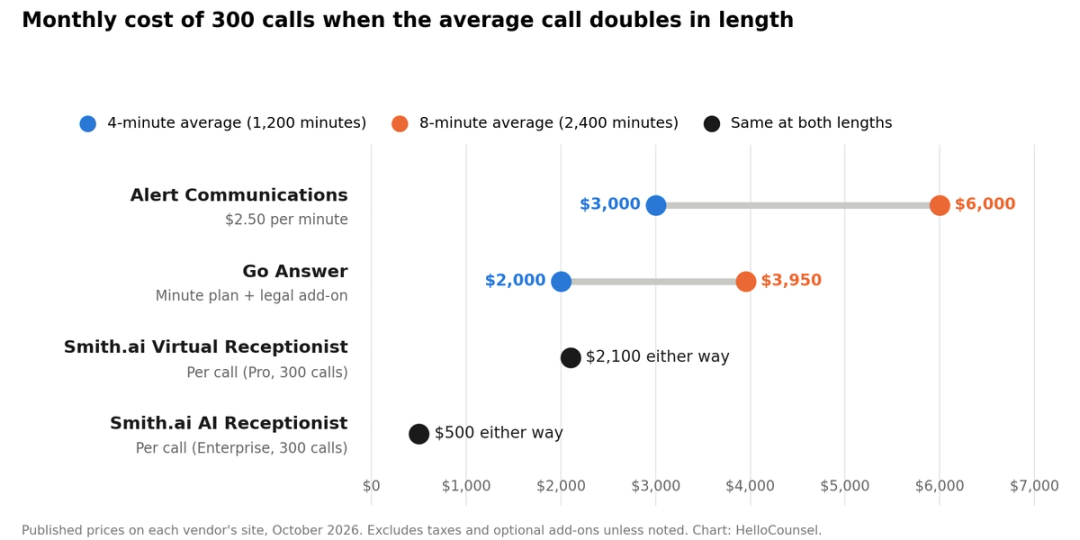
The per-minute bills double when calls double in length, which is common in PI intake where callers describe an accident, injuries, and treatment. Per-call plans stay flat on length, but Smith.ai's human plan would rise to $3,375 if a campaign pushed volume to 450 calls.
Add-ons widen the gap further. Smith.ai's extended intake would add $450 at 300 calls, and Ruby's 500-minute plan at $1,725 would not cover either scenario without overage it does not publish.
HelloCounsel prices on call and case volume and bills only for completed tasks, so the quote does not move when an intake runs long. The receptionist agent comes in at one-fourth of virtual receptionist pricing, and the same agents keep working after intake on records, case opening, and client check-ins.
Price HelloCounsel on your real call volume
Bring last month's call count and one workflow your team handles today. We'll show you what the agent completes and what it would cost. Book a demo
Frequently Asked Questions
These are the questions PI firms most often need answered before narrowing the shortlist.
1. What is the best legal answering service for personal injury firms?
It depends on the call mix. HelloCounsel fits broader PI call operations, Alert fits campaign-scale intake, Answering Legal and LEX fit legal-trained human reception, and Blazeo fits firms that want voice plus other lead channels.
2. How much does a legal answering service cost?
Published entry points run from about $100 to $300 a month, and higher-volume plans reach into the thousands. Final cost depends on minutes or calls, rounding, overage, retainers, setup, integrations, and add-ons such as bilingual or extended intake.
3. Is per-minute or per-call pricing better for a PI firm?
Per-minute pricing suits short, predictable calls. Per-call pricing protects against long intake conversations but rises with call volume, so model both against your average call length, monthly volume, and campaign spikes before choosing.
4. Do legal answering services make outbound calls?
Several do, including LEX Reception, Blazeo, Smith.ai, and Ruby. Outbound scope varies widely, so verify the exact task, retry rules, billing, escalation, and system update your firm needs.
5. What is the difference between a legal answering service and a general answering service?
Legal services train around law-firm intake, terminology, routing, and confidentiality expectations. General providers can still work well, but firms may need more configuration and testing to reach the same practice-specific intake depth.
6. Can HelloCounsel replace a human legal answering service?
HelloCounsel can take over reception and the follow-up calls an answering service never touches, answering in under two rings and writing every call into the case file. Firms that want a live person on every call can still keep human overflow coverage.
Share this article