
- Federal law caps what a provider may charge an individual for their own records, and the cap excludes search and retrieval entirely.
- Requests your firm sends under a signed authorization sit outside that cap and pay whatever the state schedule allows.
- Those two prices buy identical records, which is the arbitrage almost nobody prices into a case budget.
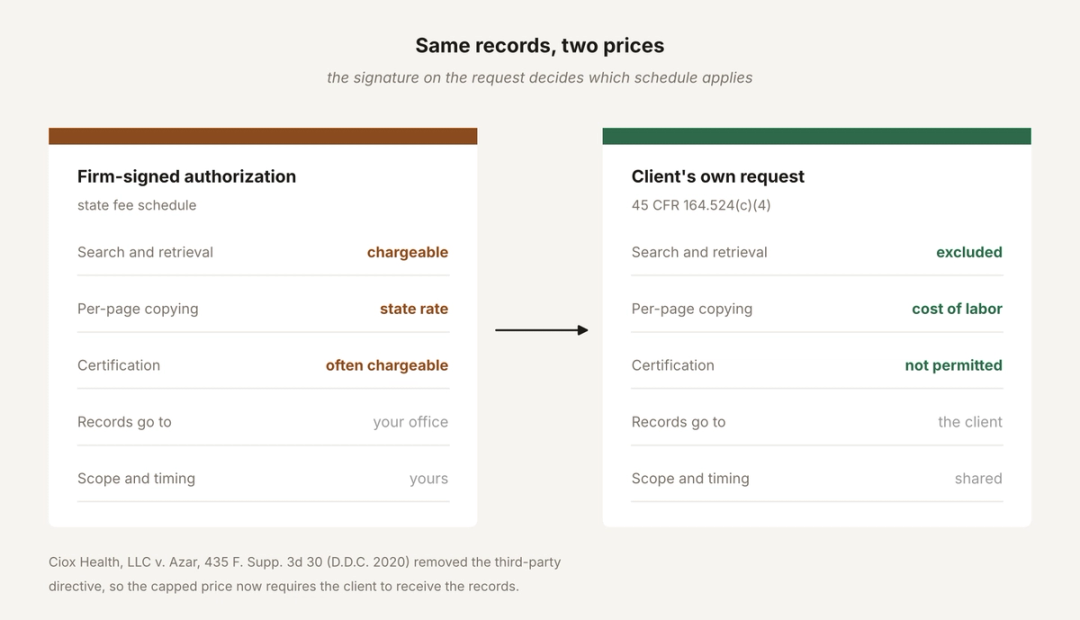
- Ciox Health v. Azar removed the third-party directive from the access framework in 2020, which is why the cheaper route now runs through the client instead of your office.
- One study of 83 hospitals found quotes for the same 200-page record running from $0.00 to $541.50.
- Switching requesters costs you a step and some control over scope, and on a multi-provider matter it can be the difference between a four-figure disbursement line and a two-figure one.
Medical record retrieval costs get budgeted as a single line item, which is how firms end up surprised by them. Two prices exist for the same documents, and which one you pay depends on whose signature is on the request.
Pricing splits along that line. Providers answering an individual's request for their own chart work under a federal cap.
Answering a firm-signed authorization puts the same provider under the state fee schedule, which in several states permits a per-page rate plus a search fee plus certification. Nothing requires that provider to quote you the lower number.
This piece covers what the federal rule actually limits, why a 2020 case split the two routes apart, and how to decide which one a given matter should use.
What the federal rule caps, and what it leaves out
45 CFR 164.524(c)(4) lets a covered entity charge an individual "a reasonable, cost-based fee, provided that the fee includes only the cost of" four things.
Labor for copying the records, whether paper or electronic. Supplies, where the individual asks for a copy on portable media.
Postage, where they ask for it mailed. Preparing an explanation or summary, where the individual agreed to one.
Read the word "only" carefully, because it does the work. Search and retrieval appear nowhere on that list. Time a records clerk spends locating a chart, pulling it from archive, or working out which facility holds it is time the provider absorbs, when the person asking is the patient.
State schedules take the opposite approach. California permits ten cents a page for standard reproduction under Evidence Code 1158, along with reasonable costs incurred in making the records available.
Other states permit a flat search fee before a single page is copied. Those charges are lawful against a firm and unlawful against the patient, for the same file.
Why Ciox closed the route firms used to take
Until 2020, a firm could capture the federal cap without giving up control, because the access rule let an individual direct their records to a third party and carried the cap along with the direction.
*Ciox Health, LLC v. Azar*, 435 F. Supp. 3d 30 (D.D.C. 2020), vacated that third-party directive as applied beyond electronic health records.
What survived is narrower. Protection still covers an individual asking for their own copy, while a request routed to your office, even on your client's signature, falls outside it.
Consequences for medical record retrieval costs here are procedural more than legal. Getting the capped price now means the client genuinely makes the request and genuinely receives the records, then hands them to you. Directing the provider to send them straight to the firm puts you back on the state schedule.
Plenty of firms read that as a reason to stop trying. Better to read it as one step added to a workflow that already has twelve.
Work out which of your open requests is on the wrong schedule Send us a month of provider invoices and we will mark the ones a client-submitted request would have priced differently. Have your invoices reviewed
What the spread actually looks like
Dispersion in medical record retrieval costs runs wider than most case budgets assume, and the best independent measurement of it is nearly a decade old because nobody has repeated the exercise.
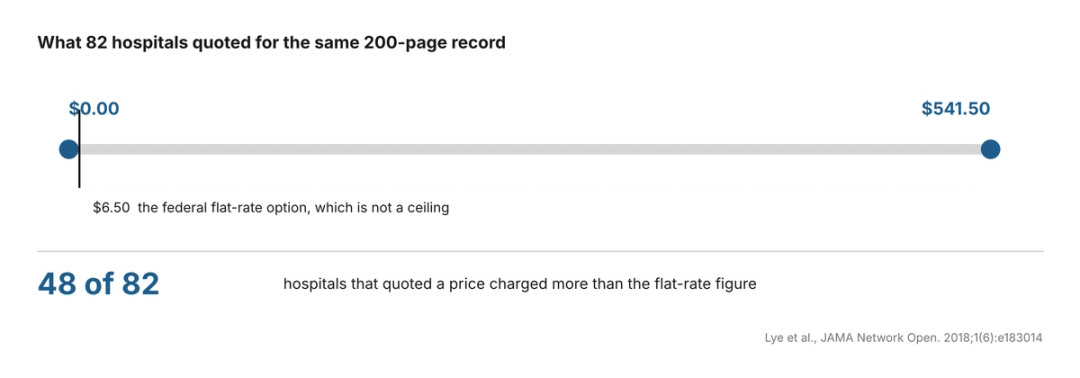
Lye and colleagues, publishing in JAMA Network Open in 2018, reviewed the release authorization forms of 83 top-ranked US hospitals and then called each medical records department as a simulated patient. For a 200-page record, the costs quoted by phone ran from $0.00 to $541.50.
Forty-eight of the 82 hospitals quoting a price came in above the $6.50 figure the federal guidance offers as a flat-rate option for electronically maintained records. That option has never been a ceiling, and treating it as one is the single most common misreading in this area.
Researchers also found that hospital forms understate what is available. Only 44 of the 83, barely more than half, offered patients the option on the form to request the entire medical record, while by telephone all 83 said they could release it.
Running the comparison on a real matter
Worked examples beat a rate table here, because medical record retrieval costs track provider count more closely than per-page rate.
Take a soft-tissue case with six providers. An ambulance service, an emergency department, an orthopedist, an imaging center, a physical therapy practice, and the primary care physician.
Under a state schedule permitting a search fee plus per-page copying, each provider bills a search fee whether the chart runs to eight pages or eight hundred. Six search fees arrive before any copying is counted.
Under the federal cost-based standard, those six search fees are not chargeable at all. Labor for copying remains, supplies if media is involved, postage if mailed.
Put rough numbers on it. Say four of the six hold files under thirty pages, which is normal for an ambulance run sheet, an imaging report and two sets of office notes. Charging a search fee on each of those four attaches a fixed cost to very little copying, and it is charged whether the file runs to eight pages or eighty.
Copying itself is the part everyone budgets for, and on a thin file it is the smaller half of the invoice. Strip the search fees and what remains on those four providers is a few dollars of labor each.
Shape of the arbitrage follows from that. Shape of it widens with provider count and narrows with page count, which means it pays best on exactly the matters firms treat as routine.
| Firm-signed authorization | Client's own request | |
|---|---|---|
| Governing rule | State fee schedule | 45 CFR 164.524(c)(4) |
| Search and retrieval | Chargeable where the state allows | Excluded |
| Per-page copying | State rate | Cost of labor |
| Certification | Often chargeable | Outside the permitted costs |
| Who receives the file | Your office | The client, who forwards it |
| Control over scope and timing | Yours | Shared with the client |
When the cheaper route is the wrong one
Cutting medical record retrieval costs this way carries a real price, and on some matters that price exceeds the saving.
Scope is the first problem. Requests your office drafts ask for what you need in the words you chose, while a client asking for their own records asks for what they understood you to want.
Both rarely come out the same on a complex treatment history. Incomplete production means a second request, and a second cycle through the custodian's queue.
Timing is the second. Our note on how long medical records actually take covers why the deadline that governs depends on which instrument you sent. Routing through the client buys the federal clock along with the federal price, which cuts the other way and usually argues for switching.
Client burden is the third and the one firms underweight. Claimants managing treatment, work and a damaged vehicle are being asked to run six administrative errands.
Some will do it well. Others will do it late or not at all, and the firm finds out in month three.
A practical rule falls out of this. Switch requesters where provider count is high and the client is organized, and keep the authorization where the treatment history is complex or the client is struggling. Decide it per matter, not as firm policy.
Building it into intake rather than bolting it on
Intake is where medical record retrieval costs actually get decided, because that is where the provider list gets built and where the client is most willing to sign things.
Keeping the option open means two signatures at sign-up instead of one. You already take the authorization, and the second is a right-of-access request the client can submit themselves, prepared and addressed so the only thing left is sending it.
Capturing both costs one extra minute on a call that already runs twenty.
Your provider list has to be complete at that point too. Any seventh provider surfacing in month two gets the authorization treatment by default, because nobody is going back to the client for another signature over one clinic. We covered how many calls a PI case generates covers how quickly that list grows past what a first call captured.
Find out what your intake is leaving on the table
Give us a recent intake record and we will show you what the records on that matter would have cost each way. Price a real matter
How HelloCounsel handles the records question at intake
HelloCounsel is our product, so read this as a description of design choices and not a neutral assessment.
HelloCounsel's intake agent asks for facilities instead of physicians, then follows any named doctor with a question about where that doctor practices, because institutions hold the records and clients name people.
Provider count is captured as a field instead of inferred from a call summary, which is what makes the routing decision possible before anyone drafts a request. Six custodians and two custodians are different economic problems. Our note on reducing case manager workload covers what the difference costs in staff hours.
Both authorization and right-of-access consent are flagged at sign-up, so the firm keeps the choice instead of defaulting into the expensive route by omission.
Everything written to the case management system arrives as structured fields, covered in our note on CMS write-back.
What these costs do at settlement
Records charges are advanced case costs, which means the schedule you paid under follows the matter all the way to the disbursement sheet and comes out of the client's recovery.
Model Rule 1.5(c) requires a contingent fee agreement to be in writing and signed by the client. It must state the method by which the fee is determined, along with the "litigation and other expenses to be deducted from the recovery" and whether those expenses come out before or after the fee is calculated. Ordering matters more than firms tend to explain to clients, because deducting costs before the percentage is calculated produces a different number for both sides than deducting afterwards.
Rule 1.5(c) also requires the agreement to "clearly notify the client of any expenses for which the client will be liable whether or not the client is the prevailing party," and requires a written statement of the outcome at the conclusion of the matter.
Read those requirements alongside the fee question and the client's interest becomes concrete. On a six-provider matter, the difference between the two schedules is money that lands on their disbursement sheet instead of yours. Firms that routinely take the more expensive route without considering the alternative are making that choice on the client's behalf, with the client's money, and will account for it in writing at the end.
None of which makes the authorization route improper. Running the comparison becomes worthwhile on matters where the spread is wide, and worth being able to explain if a client asks why the records line reads the way it does.
When the invoice is wrong
Reporting the rates is where every page on this topic stops. What a paralegal does with an invoice that breaks them is the part nobody covers.
Three charges are worth checking on any bill against a client-submitted request. First, any search or retrieval line, which the federal standard excludes outright.
Second, a certification fee, which sits outside the four permitted costs. Third, any per-page rate lifted from the state schedule, which governs a different requester than the one who signed.
Raise it with the records department first, in writing, naming the request date and citing the cost-based standard instead of arguing about the amount. Billing staff at most institutions are applying a default schedule and not making a decision. A written objection naming the governing rule gets re-rated more often than a phone call does.
Where that fails, the Office for Civil Rights takes complaints about access denials, and an inflated fee that effectively prevents a patient from obtaining their records counts as a denial, not a billing dispute. See why PI firms lose cases before they sign them covers the broader pattern of administrative friction becoming case risk. Firms rarely get that far, because the prospect of a federal complaint usually resolves the invoice.
Worth keeping a short record of each dispute and its outcome. Which providers re-rate on request and which argue is useful to know before the next matter, and the pattern tends to hold.
What to measure
Tracking medical record retrieval costs as one number per case hides the only thing worth knowing.
Track cost per provider instead of cost per matter, since provider count is what actually moves the number. Track search fees as a share of records spend, which is the portion that would disappear under the federal standard. And watch the share of matters where the client submitted at least one request, which tells you whether the option you built is actually being used.
Zero client-submitted requests against a well-drafted dual-consent process means you built something nobody reaches for, which is worth knowing early.
Deciding what to do about it
Medical record retrieval costs come down to a question of whose name is on the request, and the answer varies matter by matter.
Federal pricing is cheaper because it excludes search and retrieval. State schedules are more convenient because your office keeps control. Neither is correct in general, and a firm that has only ever used one has never priced the other.
Start by pulling a quarter of provider billing and marking every search fee on it. Whatever that totals is what medical record retrieval costs are worth arguing about at your firm.
Bring us the invoice that annoyed you most
Show us the records bill you thought was too high and we will tell you which schedule it was written under. Talk to the HelloCounsel founders
Frequently asked questions
1. Does the $6.50 flat rate cap what a provider can charge?
No. Federal guidance offers it as an optional flat rate for electronically maintained records, and providers may instead charge an actual cost-based fee. In the hospital study above, 48 of 82 that disclosed a cost were above it.
2. Can a provider charge my firm a search fee?
Where state law permits it, yes. Exclusion of search and retrieval covers an individual requesting their own records, so a firm-signed authorization falls outside it and picks up whatever the state schedule allows.
3. What did Ciox Health v. Azar change about fees?
It vacated the third-party directive from the right-of-access framework beyond electronic health records. Before that ruling, a client could direct records to a firm and carry the federal fee limit along. Afterwards, records directed to a third party sit outside the limit.
4. Can we just have the client request everything?
Sometimes, and where it works it is worth doing. Elsewhere the loss of control over scope produces an incomplete production and a second request, which costs more in elapsed time than the fee difference saves in dollars.
5. Are these costs recoverable from the client at settlement?
They are normally advanced case costs recovered from the settlement, which means the fee schedule you paid under shows up on the client's disbursement sheet. Your fee agreement should say how costs are advanced and recovered, and the lower schedule leaves the client with more.
6. Do state fee schedules change?
Several states index their schedules annually, so a figure accurate last year may not be this year. Check the current published schedule from the state agency instead of relying on a rate carried over from a prior matter.
Share this article