AI Receptionist vs. Answering Service for Law Firms

- The AI receptionist vs answering service decision is hard to price because the two bill in different units, so a per-minute rate and a per-call rate cannot be compared directly.
- A 400-call month costs $2,412 on a published per-minute plan and $2,950 on a published per-call plan, and the same month reaches $3,950 once Spanish and outbound are added.
- Rounding increments, overage rates, and after-hours surcharges move the invoice more than the headline rate does, and several vendors set those in the agreement rather than publishing them.
- Per-call pricing protects you on long intake calls and punishes you on short ones, while per-minute pricing does the reverse.
- Audit contact rate, qualification accuracy, and what reaches your case management system in the first 90 days, because those three explain almost every renewal dispute.
Most firms compare these two on rate and get stuck, because a per-minute rate and a per-call rate are not the same kind of number. One bills how long your caller talks. The other bills that the call happened at all.
That difference decides which model is cheaper at your volume, and it moves the answer by thousands of dollars a month in either direction. It also explains why two firms running the same call load get opposite advice from the same pair of vendors.
This piece prices the AI receptionist vs answering service question rather than defining it. If you want the definitional version, covering what each model does and where each genuinely wins, our guide to AI versus live answering services handles that ground.
Answering services and AI receptionists bill in three different units
The market prices this work three ways, and the third is the one buyers leave out of the spreadsheet when they run an AI receptionist vs answering service comparison.
| Billing unit | What triggers a charge? | What it rewards | Typical of |
|---|---|---|---|
| Per minute | Talk time, usually rounded up | Short calls | Traditional answering services |
| Per call | The call connecting, regardless of length | Long, thorough calls | Newer AI receptionists and some hybrids |
| Fixed monthly | Nothing during the month | Predictable volume planning | Agents scoped to expected volume |
Per-minute billing makes your most thorough personal injury intake the most expensive call of the day. Per-call billing fixes that and charges full freight for a wrong number.
Fixed monthly removes both effects and asks you to scope honestly up front instead. HelloCounsel prices this way, starting at $500 a month with 20% tolerance either way on volume.
What arethe 400-call costs on each pricing model
Take a firm handling 400 calls a month: 120 new claimants averaging seven minutes and 280 other calls averaging two and a half. That is 1,540 minutes.
On PATLive's published rates, the cheapest fitting plan is 1,000 minutes at $1,499, plus 540 overage minutes at $1.69, which comes to $2,412. On Smith.ai's published per-call rates, the Pro plan covers 300 calls at $2,100, plus 100 calls over at $8.50, which comes to $2,950.
The gap widens as volume climbs. At 900 calls the per-minute plan reaches $4,935 while the per-call plan reaches $7,200, and at that point most vendors move you to a quoted enterprise tier anyway.
Published rates across both sides of this decision, verified September 2026:
| Vendor | Model | Published rate | Overage |
|---|---|---|---|
| PATLive | Per minute, staffed | $49 pay as you go up to $6,899 for 5,000 minutes | $1.49 to $2.99 a minute by plan size |
| Ruby | Per minute, staffed | $250 for 50 minutes up to $1,725 for 500 | Not published |
| Smith.ai staffed | Per call, staffed | $300 for 30 calls up to $2,100 for 300 | $8.50 to $11.50 a call |
| Smith.ai AI | Per call, AI | Free for 25 calls, $150 monthly, $500 monthly | $1.67 to $3.00 a call |
| LEX Reception | Per minute, staffed | Quote only, listed from $425 monthly | Not published, full-minute rounding |
| Answering Legal | Per minute, staffed | Quote only, 10-day trial with 400 minutes | Set in your agreement |
| Alert Communications | Per minute, staffed | Quote only, $2.50 a minute against a $100 floor | Not published |
| HelloCounsel | Fixed monthly, AI | From $500 monthly, scoped to volume | None, 20% tolerance either way |
Two things stand out in that table. Four of the eight publish no overage rate, and the AI plans charge about a fifth of the staffed rate for the same connection.
Run this against your own numbers before you shortlist anyone. Our breakdown of how many calls a PI case generates gives you the volume to plug in.
Six contract terms that change the invoice more than the rate does
Headline rates are the part vendors publish. In an AI receptionist vs answering service comparison the invoice is built from things further down the agreement.
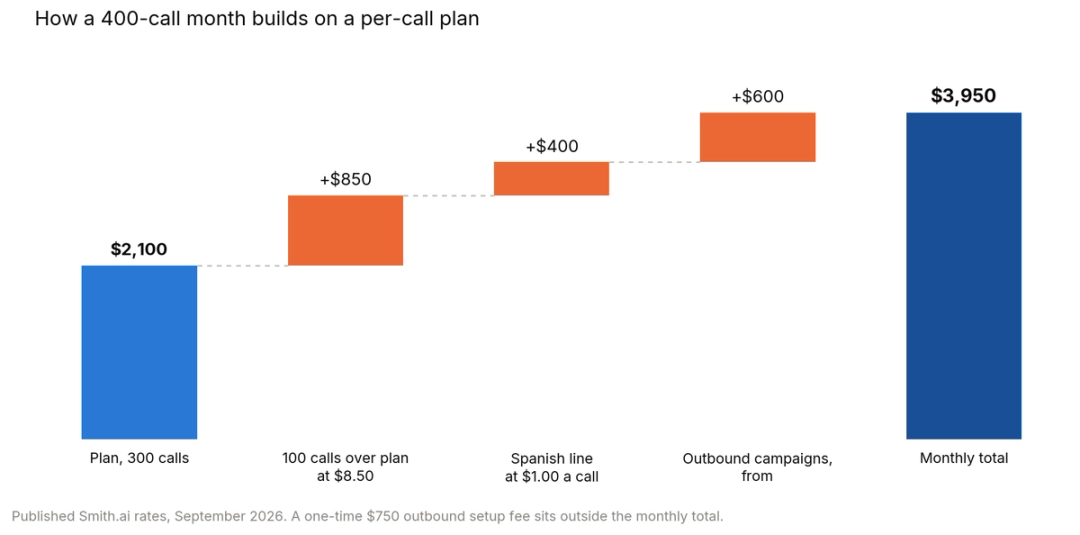
Adding a Spanish line and outbound campaigns to that same 400-call month takes it from $2,950 to $3,950, with a one-time $750 outbound setup fee on top. Nothing in that increase came from the per-call rate changing.
These are the terms that account for most of the variance between the quote and the invoice.
Rounding increment. LEX Reception rounds up to the full minute, so a call lasting two minutes and twenty seconds bills as three. Back Office Betties rounds the same way. Several vendors do not publish their increment at all, which is worth asking about in writing.
Overage rate. Ruby publishes plan prices but not its overage rate. Answering Legal sets the rate in your agreement rather than on the site. Overage is where a campaign month stops resembling the quote.
After-hours treatment. Most vendors include nights and weekends. Back Office Betties operates Monday to Friday, 5am to 5pm Pacific, and routes everything outside that to voicemail, which is a coverage gap rather than a pricing term but shows up the same way in results.
Bilingual access. Smith.ai prices a dedicated Spanish line at $1.00 per call on its staffed plans. Alert Communications and Answering Legal include bilingual coverage at no extra charge.
Outbound. Inbound quotes rarely include it. Smith.ai sells outbound as Outreach Campaigns starting at $600 a month with a $750 setup fee and a 50-contact minimum at $12 per contact.
Setup and minimums. Smith.ai and Ruby charge no setup fee. LEX Reception carries a $75 one-time setup on its entry plan. Alert Communications requires a refundable deposit upfront.
Reviewers describe the effect of these terms more plainly than any pricing page does. A G2 reviewer rating Ruby 2.5 out of 5 reports "discrepancies between the calls made and the time billed" alongside "no clear explanation of the billing model."
Another on the same platform notes that "pricing tiers are a bit wide and lead to a lot of overage minutes," which is the structural problem rather than a service failure. On Capterra, an attorney describes going over plan and being offered a block of calls "much larger than I needed and wouldn't be cost effective."
Minimum terms, unused volume, and notice periods
Pricing pages describe what you pay. Agreements describe what happens when the fit turns out wrong, and that section is shorter and more consequential.
Three terms decide how expensive a mistake is. The minimum commitment, whether unused volume carries forward or expires, and the notice period required to end the arrangement.
Smith.ai runs month to month on its published plans with a 30-day money-back guarantee, and Answering Legal states no contract with cancellation at any time. Those are the easier end of the category.
The harder end shows up in reviews. A September 2026 Trustpilot reviewer describes being unable to recover unused months on a $2,500 six-month contract for an account that was never set up.
Ask three questions before signing any of them. What is the minimum term, what happens to volume you paid for and did not use, and how much notice does cancellation require. A vendor confident in the service answers all three in writing without hesitation.
What evidence each model gives you when something goes wrong
The two models differ on evidence as much as on price, and that gap only becomes visible once something goes wrong.
A staffed answering service produces a call log and a message. Some provide recordings on request, and transcripts are uncommon unless you pay for them.
An AI agent produces a transcript of every call by default, because transcription is how it works rather than an add-on. That changes what a monthly review can actually examine, since you can read what was said rather than infer it from a summary.
The practical difference lands on qualification disputes. When a firm believes a caller was screened out wrongly, a transcript settles it in minutes and a message log does not.
That evidence question also decides how useful the missed call analysis is at renewal, since you can only audit what the vendor records.
Price the whole line before you compare quotes
Ask each vendor to put the rounding increment, the overage rate, and the after-hours policy in writing. Then re-run their quote at 150% of your current volume, and negotiate with whichever number moves least. Book a demo
Where the crossover between per-minute and per-call sits
Per-call pricing wins when your calls run long. A twelve-minute intake costs the same as a wrong number, which is the right incentive for a firm whose value sits in thorough qualification.
Per-minute pricing has the advantage on short calls. A firm fielding mostly quick status questions pays for the seconds used rather than a flat fee per connection.
Run the same 400-call month across a range of call lengths and the two models cross at about five minutes.
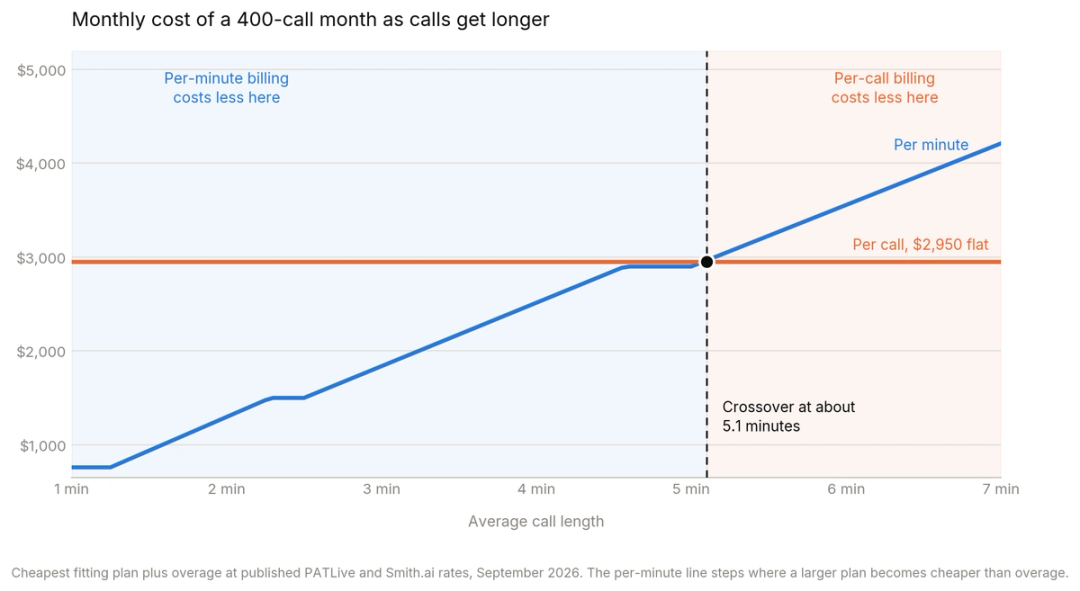
Below roughly five minutes of average call length, per-minute billing costs less. Above it, per-call does.
Work out your own average from last month's logs, because that single number settles more of this decision than any feature comparison will. Our legal answering service cost guide runs the same math across more volumes.
What a campaign month does to a metered bill
Metered pricing behaves worst in exactly the month a plaintiff firm most needs coverage.
A mass tort placement or a television flight doubles inbound for two or three weeks. On a per-minute plan that lands as overage at the highest rate in the agreement, because you have already cleared the plan allowance.
Price that same firm at 900 calls and 3,400 minutes. The per-minute bill reaches $4,935 and the per-call bill reaches $7,200, against $2,412 and $2,950 at normal volume.
Fixed monthly pricing absorbs the same spike without a line item, which is the whole argument for it. The trade is that you scope the plan honestly at the start rather than discovering the number afterwards.
Three numbers to audit in the first 90 days
Most renewal disputes trace to something nobody measured in month one. These three catch almost all of them.
Contact rate against your own call log. Pull your carrier records and compare total inbound against calls the vendor reports handling. A gap here means calls are reaching voicemail somewhere in the chain, which is the failure the service was bought to remove.
Qualification accuracy. Take ten calls the vendor marked unqualified and listen to them. This audit takes an hour and catches the most common complaint in this category, where the script the firm designed is not the script that ran.
What reached your system. Check whether the call produced a record in your case management system or an email somebody re-keyed. CMS write-back is the difference between a call that happened and a call the file can prove happened.
Run those three monthly and the renewal conversation becomes a review of evidence rather than an argument about impressions.
Where HelloCounsel fits in this comparison
HelloCounsel is our own product, and it sits on the AI side of this question with a different commercial model from the metered vendors above.
Pricing is fixed monthly from $500, scoped to your licence count and expected volume with 20% tolerance either way. A campaign month costs what a quiet month costs, which removes the overage line entirely rather than negotiating it. There is no setup fee, and billing passes through by case as an itemized expense.
The operational difference is what the agent does after it answers. It identifies the caller against the case file before the call is handled, runs your qualification criteria on new callers, and opens the matter once the fee agreement lands.
Records retrieval, treatment check-ins, and lead follow-up run on the same agents rather than as separately billed add-ons. Direct integrations cover SmartAdvocate, Filevine, Litify, and Lead Docket, with custom builds for other systems, so the outcome of each call lands in the matter.
Across 30,000 calls and 500 hours of call time, firms working with us have seen a 48% improvement in call reception rates. Onboarding runs one hour with 17 multiple-choice questions, and agents go live in SmartAdvocate in about a week.
The limits are worth stating. HelloCounsel works in English and Spanish only, it runs inside your case management system rather than replacing it, and firms tracking cases in spreadsheets are not a fit. Human escalation is available on any flow for firms that want a person on sensitive calls.
How to choose between an AI receptionist and an answering service
Start with your average call length, because it settles the AI receptionist vs answering service cost question before any other factor applies. Under roughly five minutes, per-minute billing wins. Above it, per-call does.
Then ask whether your volume is stable. Metered pricing is fine when call load is predictable and punishing when marketing spend moves it, which is the argument for a fixed monthly plan rather than a better rate.
Then decide what you want the vendor responsible for. A service that answers and takes a message is a different purchase from an agent that qualifies the caller and opens the file, and the ROI math changes accordingly.
Our guide to choosing a phone answering service covers the procurement steps in order.
What to work out before your next vendor call
The AI receptionist vs answering service question is usually framed as a choice about voice quality, and priced as a choice about rate. It is neither. It is a choice about which unit you want your phone bill indexed to, and whether that unit moves with the months you most need coverage.
Work out two numbers before you take another demo: your average call length, and how far your volume moves in a campaign month. They narrow the field faster than any feature list, and they tell you which quotes are worth reading closely.
Get a fixed monthly figure against your own numbers
Send last month's call volume, your average call length, and your case management system. We will come back with a scoped monthly price, what it covers beyond answering, and a walkthrough on three of your own recordings. Talk to the HelloCounsel founders
Frequently asked questions
1. Is an AI receptionist cheaper than an answering service?
Usually at higher volume, since published AI plans charge between $1.67 and $3.00 for a call that costs $8.50 to $11.50 on a staffed plan. At low volume the gap narrows, and fixed monthly pricing removes the comparison by not metering at all.
2. How much does an AI receptionist cost for a law firm?
Published AI plans run from free at 25 calls a month to $500 monthly at around $1.67 per call. HelloCounsel charges a flat monthly fee starting at $500, set against expected volume with 20% tolerance.
3. What does an answering service charge per minute?
Published per-minute rates run from about $1.49 to $2.99 depending on plan size, with most vendors billing in full-minute increments. Overage rates often sit in the agreement rather than on the pricing page.
4. Which is better for personal injury intake?
Per-call or fixed pricing suits PI better, since thorough intake calls run long and metered minutes turn your most valuable conversations into your most expensive ones.
5. Do AI receptionists handle calls after the client signs?
HelloCounsel does! The same agents handle case opening, record retrieval, client check-ins after treatment, and follow-up on leads, with human escalation available on any flow.
6. What should a firm check before switching?
Get the rounding increment, overage rate, and after-hours treatment documented in the agreement. Then price the same quote at 150% of current volume and compare how far each one moves.
Share this article