How to Choose a Legal Intake Service for Your Law Firm

- How to choose a legal intake service starts with which part of your intake is leaking, because coverage, qualification, and paperwork each fail differently and each needs a different fix.
- Start with your own phone system: the live contact rate on new-claimant calls, median time to first contact, how often an intake decision matched the lawyer's, and the after-hours share.
- ABA Formal Opinion 506 lets a trained non-lawyer run the conflict check, explain how fees work and send the fee agreement, while anything calling for legal judgment has to reach a lawyer.
- Outsourcing the work does not move the duty: under ABA Opinion 08-451, the supervision, the confidentiality, and the competence stay with your firm.
- Settle data portability in the contract, since recordings, transcripts, and intake records are the assets you will want back on the day you switch.
A legal intake service takes over part of what happens between a potential client's first contact and a signed fee agreement. Vendors in the category take over different parts of it, which is why their pricing looks comparable and their results are not.
At most plaintiff firms that sequence runs something like this. A new claimant calls at 9pm, the call routes to an after-hours line, and someone takes a name, a number and a sentence about the crash. The message reaches an inbox overnight.
An intake specialist opens it the next morning and calls back. The claimant does not pick up, and answers on the third attempt two days later.
The specialist runs the qualification questions, decides the case is worth taking, and emails a fee agreement. It comes back signed on Friday. The matter is opened on Monday.
That sequence contains six handoffs, and nobody in it did anything wrong. A legal intake service replaces some of those handoffs and leaves the rest where they are, which is why two firms can buy the same service and see very different results.
Knowing how to choose a legal intake service therefore starts with identifying which handoff is costing you cases. A plaintiff firm's intake can fail in four places, those failures have different causes, and only one of them is solved by answering the phone faster.
What a legal intake service does that an answering service does not
The distinction is the unit of work. An answering service is paid to handle the call. An intake service is paid to advance the lead, which means reaching it, qualifying it against your criteria, clearing conflicts, getting the fee agreement signed, and opening the matter.
| Model | Unit of work | Ends when | What comes back to you |
|---|---|---|---|
| Answering service | The call | The caller is greeted, and a message is taken. | A message, usually four fields |
| Legal intake service | The lead | The prospect is qualified, signed, or declined. | A qualified record, fee agreement, and matter |
| In-house intake team | The lead | Same, with your own staff and your own supervision | The same, plus full control of the script |
Some vendors sell both under one name, so the useful question in a demo is not which category they call themselves. It is where they stop.
Ask what happens to a caller who qualifies at 9pm on a Friday. The answer tells you the unit of work faster than the pricing page will.
Our guide to choosing a phone answering service covers the narrower category in full.
For who is currently in the market, the legal intake answering services roundup has the roster.
Four numbers to pull from your own call data before you contact a vendor
All four sit in your phone system and your case management system already. Pulling them takes an afternoon and changes which vendors are worth a demo, as the hidden cost of missed calls shows once the contact rate is in front of you.
Without them, two firms with identical signed-case counts look identical on paper. One might reach 90% of its new claimants and sign 18 of every 100, while the other reaches half of them and signs 40 of the ones it does reach.
Buying coverage transforms the second firm and does almost nothing for the first, which is one of the reasons firms lose cases before they sign them.
Live contact rate on new-claimant calls. Of the calls from people who had never contacted the firm before, what share reached a person on the first attempt. Not answered, reached.
Median time to first contact for form and web leads. Measured from submission to a human voice, not to the automated acknowledgement.
Qualification agreement rate. Take 50 recent intake decisions, have an attorney review them cold, and count how often the attorney would have decided the same way. This is the number almost nobody has and the one that separates a coverage problem from a judgment problem.
After-hours share of new-claimant calls. What proportion arrives outside your staffed hours, including weekends.
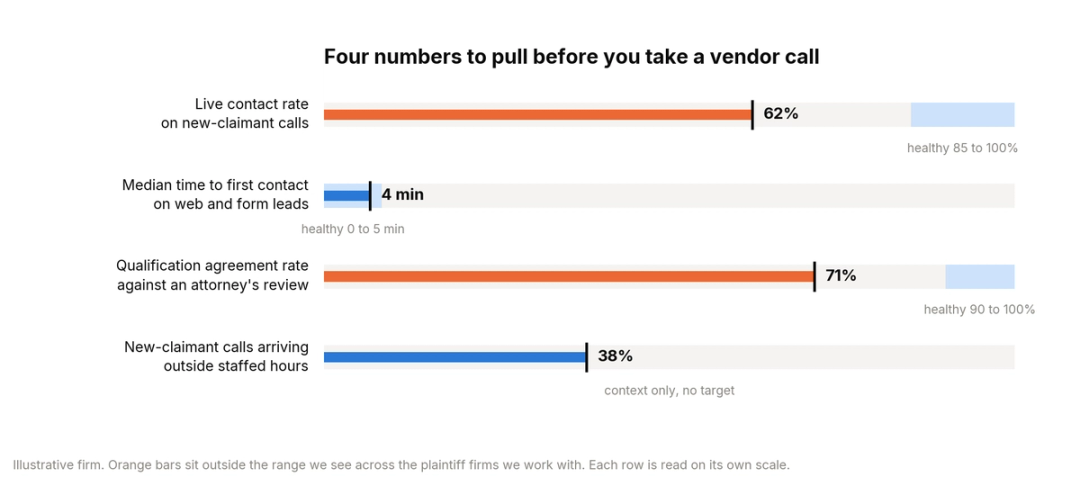
Run them together rather than one at a time. A firm reaching 62% of its new claimants with a qualification agreement rate of 71% has two separate problems, and a vendor that fixes the first will leave the second exactly where it is.
What each intake failure pattern tells you to buy
Each pattern below points at a different purchase, and one of them points at no purchase at all.
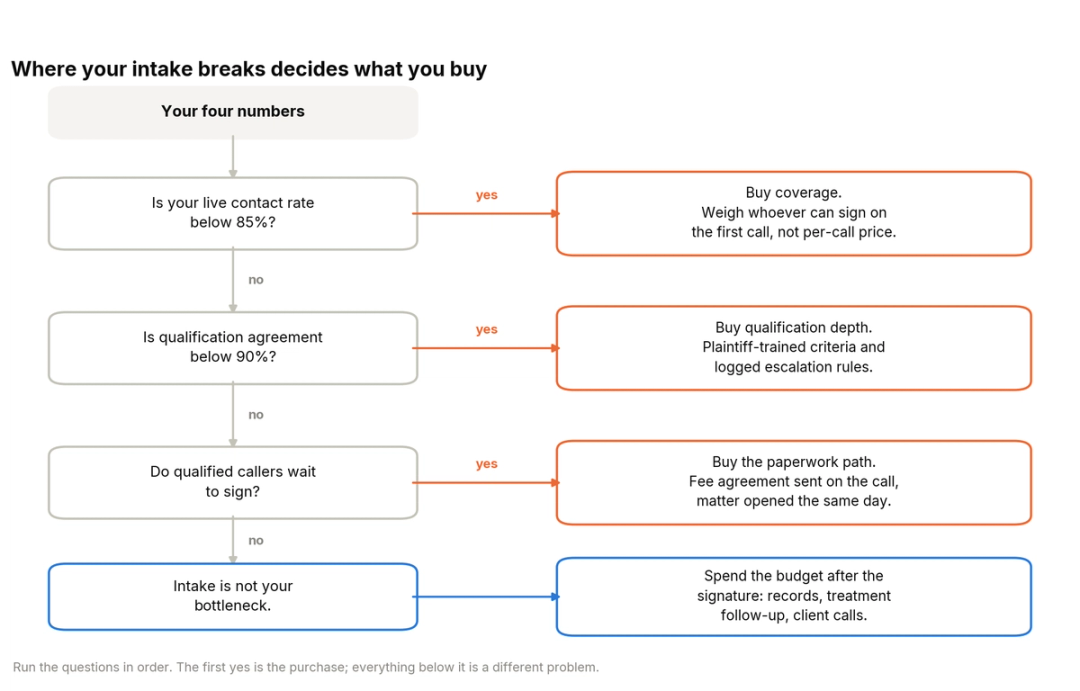
Low contact rate with a high after-hours share. This is a coverage problem. Any service that answers around the clock moves it, so the deciding factors become cost at your volume and whether the qualified caller can be signed on that first call rather than handed back as a message.
Strong contact rate with weak qualification agreement. More coverage makes this worse, since it puts more decisions through the same judgment. What you need is a service trained on plaintiff criteria specifically, with escalation rules written down and a record of when they fired.
Good qualification with slow signing. The gap sits between the yes and the signature. E-signature, a fee agreement that goes out during the call, and the ability to open the matter without waiting for Monday are the capabilities that close it.
Healthy intake, cases stalling afterward. No intake service fixes this. The work sitting behind it is records, treatment follow-up and client communication, and buying intake coverage adds a vendor without moving the number. Case manager workload is the file to open instead.
What an intake service is allowed to do on your behalf
This is the part most feature comparisons skip, and it decides how much of the work can actually leave your building.
In Formal Opinion 506, issued on 7 June 2023, the ABA Standing Committee on Ethics and Professional Responsibility set out what a trained non-lawyer may do during intake. The list is wider than most firms assume. A non-lawyer may gather initial information about the matter, run the initial conflict check, confirm the matter fits the firm's practice areas, explain how fees and costs are charged, and obtain the prospective client's signature on the fee agreement.
The limits are equally clear. A question that requires legal judgment, or applying law to the caller's facts, has to reach a lawyer, and so does fee negotiation.
The same goes for any reading of what the engagement agreement obliges either side to do. The prospect must also be able to raise the agreement and the scope of representation with a lawyer before signing.
Read as a buying criterion, that turns into three demo questions. Can the service recognise a question it is not allowed to answer, and what does it do next when it does.
The third question is whether you can see afterwards that it happened, with the call attached to the matter rather than summarised in an email. CMS write-back is the capability that decides it.
A service that routes every judgment question to a voicemail box technically complies and practically loses the case. The escalation path is worth more scrutiny than the script.
Score your own intake before you shortlist
Pull the four numbers, review 50 intake decisions against an attorney's read, and you will know which of the four failures you have. It takes an afternoon and it removes most of the shortlist. Book a demo
What stays your responsibility when intake sits outside the firm
Handing the work to a vendor leaves the duty where it was. Formal Opinion 08-451, issued in August 2008 and still the reference point, holds that a lawyer outsourcing legal or non-legal support services remains responsible for competent representation. Supervision, confidentiality and conflict screening travel with you.
Two consequences matter at signing. The vendor needs its own conflict screening so it is not running intake for both sides of the same collision. The confidentiality obligation also means you should know where the work is performed, who has access to the recordings, and whether anything said on your calls trains a model.
Protected health information adds a second layer. Plaintiff intake collects treatment detail in the first ninety seconds, and a law firm handling that information is a business associate.
The HHS guidance is explicit that a business associate must have a signed agreement with its subcontractor before disclosing protected health information to it. Your intake vendor is that subcontractor, so ask for the executed agreement rather than a compliance page.
How to design a pilot that produces a decision
Most pilots end with everyone agreeing the calls sounded fine. That is a demo with a longer runway. A pilot is a measurement, and it needs three things fixed in advance.
Set the baseline before the vendor starts. The four numbers above, taken from the two weeks before go-live, are what the pilot gets compared against. Collected afterward, they are worthless.
Route a defined slice rather than everything. After-hours and weekend new-claimant calls make the cleanest test, since the counterfactual is voicemail and the comparison is honest.
Fix the pass mark before the first call. Decide now what contact rate and qualification agreement rate would make this a yes, write both numbers down, and hold them. Deciding afterward means deciding on the tone of the recordings.
At the end, read three things: the same four baseline numbers, a sample of 20 transcripts reviewed by whoever currently makes intake decisions, and every escalation the system logged. Our checklist for evaluating an AI voice agent covers the technical half of the same review. If the vendor can only send call summaries rather than transcripts, the second check is not available to you, which is itself a finding.
Contract terms that decide what you keep when you leave
The intake record is the asset you are paying to create, and four contract terms decide whether you keep it.
Data portability. Can you export transcripts, recordings and structured intake records, in what format, and at what notice. A vendor that exports a PDF summary per call is handing back the least useful version.
Ownership of recordings. Recording consent rules vary by state and several require every party to consent, so check how the disclosure is handled and whether it follows the caller's state rather than yours.
Volume tolerance. Plaintiff volume moves with marketing spend and with any mass tort campaign. Find out what happens in a month that runs 40% above the scoped figure, and whether that is an overage charge or a re-scope.
Notice and transition. The notice period, and whether the vendor keeps answering during it, decides whether a switch is a project or a gap in coverage.
Where HelloCounsel fits
HelloCounsel is our own product, so this section names what it does rather than arguing it is the right answer for every reader.
Counsel answers the main line in under two rings, identifies the caller and the matter before the conversation starts, and runs your qualification criteria on the call. When a prospect qualifies, it opens the matter, pulls the crash report and sends the Letter of Representation. Every call is written back into the case management system as a structured record with the transcript attached, so the escalation trail that Opinion 506 makes relevant is visible in the file rather than in a vendor dashboard.
Post-signing calls run on the same agents. Medical records retrieval works provider phone trees and re-requests until the file arrives, treatment check-ins run on schedule, and follow-up closes the loop on callers who did not sign.
Pricing is fixed monthly from $500, scoped to expected volume with 20% tolerance either way, with no per-minute billing and no setup fee. Onboarding runs about an hour, built on 17 multiple-choice questions, and firms on SmartAdvocate are typically live in about a week.
Direct integrations cover SmartAdvocate, Filevine, Litify, Lead Docket and Clio, with custom builds for other systems. Across 25,000 calls and 500 hours of call time, firms working with HelloCounsel have seen a 48% improvement in call reception rates.
How to choose a legal intake service for your call mix
The four numbers decide it, and they decide it faster than a comparison table will.
A firm whose new-claimant calls are mostly arriving after hours and mostly going unanswered should buy coverage, and should weight the decision toward whoever can close the sign-up during the call rather than whoever is cheapest per call. A firm reaching its callers but disagreeing with its own intake decisions should ignore coverage pricing entirely and evaluate on qualification depth, escalation logic and what lands in the file afterward.
Firms that want a person on every intake call as a matter of policy should hire one. That is a legitimate position, clients notice it, and the four numbers still tell you whether the people you hire need to be yours or can sit outside.
A firm whose intake is already healthy should spend the budget on what happens after the signature. How many calls a PI case generates is the number that makes that case.
What to do before your next vendor call
Most of the decision happens before a vendor is on the line. Spend an afternoon on your own data: pull the four numbers, have an attorney review 50 intake decisions cold, and write down which of the four failure patterns you are looking at.
Then take three questions into every demo: what happens when a caller asks something the service is not permitted to answer, what lands in our case management system afterward, and what we can export on the day we leave. Those answers separate vendors more reliably than any feature grid, and they are the ones nobody prepares for.
Get a scoped figure against your own call mix
Send last week's call log split and your four baseline numbers. We will come back with a fixed monthly price, what it covers beyond intake, and a walkthrough on three of your own recordings. Talk to the HelloCounsel founders
Frequently asked questions
1. What is the short version of how to choose a legal intake service?
Pull four numbers from your own system, match them to the failure pattern they describe, and shortlist only vendors that address that pattern. Most firms cut the list to two or three this way in an afternoon.
2. Can an intake service sign a client on my behalf?
Yes, under ABA Opinion 506 a trained non-lawyer may obtain that signature, as long as a lawyer is available to the prospect first and the agreement says so on its face.
3. Does outsourcing intake create an ethics problem?
Not by itself. Opinion 08-451 permits it while keeping supervision, confidentiality and conflict screening with the firm, so the practical question is whether the vendor gives you enough visibility to supervise.
4. Do I need a business associate agreement with an intake vendor?
Yes, where the vendor handles treatment information on your behalf. HHS guidance requires a signed agreement with a subcontractor before protected health information is disclosed to it.
5. How long should a pilot run?
Long enough to cover a full billing cycle of your own call pattern, with the baseline captured beforehand and the pass mark written down before the first call.
6. What should I export before switching vendors?
Every call in a form your case management system can read, not a PDF summary per call. Agree that format at signing, since a vendor has little reason to negotiate it once notice is given.
Share this article