
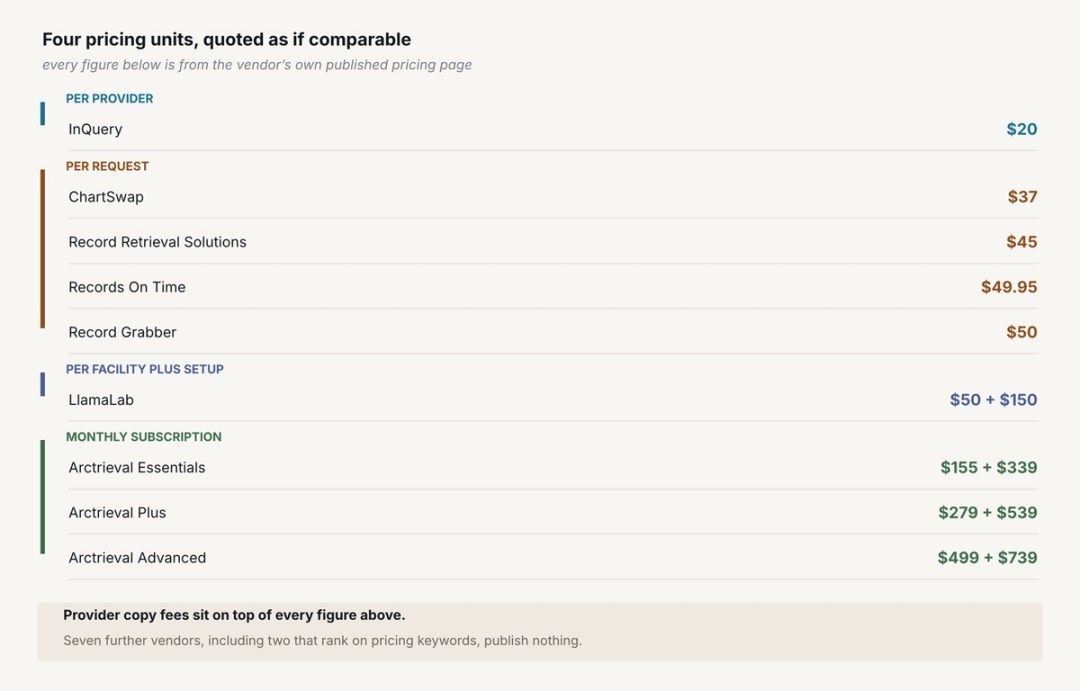
- Rates on the record sit at $20 per provider, $45 per request, $50 per facility plus a $150 case setup, and $155 to $499 a month, which are four different units comparing to nothing as written.
- Another seven vendors publish no rate at all, including several that rank on pricing keywords.
- Arctrieval charges a one-time fee of $339 to $739 alongside its subscription, a figure that appears in none of the comparison articles citing its monthly price.
- Vendor service fees and provider copy fees are separate charges, and pages that blur them produce estimates wrong by multiples.
- One provider often generates two billed requests, since medical and billing records travel separately, which doubles any per-request quote.
- Cost per completed case is the only unit that makes competing quotes comparable, and no page currently answering this question builds it.
Medical record retrieval pricing arrives in four incompatible units. One vendor charges per provider, another per request, a third per facility with a case setup fee, and a fourth sells a monthly subscription with unlimited volume.
Collect three quotes and you receive three numbers with no common basis for ranking. Twenty dollars looks cheaper than fifty, and whether it is depends entirely on how many providers a case carries and how many requests each one takes.
Every page currently answering this question is published by a company selling retrieval. HelloCounsel sells intake software, which means the comparison below costs us nothing to run honestly.
Published rates, and the seven vendors who publish none
Start with the medical record retrieval pricing that is actually on the record. These figures come from each vendor's own pricing page, read directly instead of quoted from a competitor's comparison.
| Vendor | Published rate | Unit | Provider copy fees |
|---|---|---|---|
| InQuery | $20 | Per provider | Charged on top |
| ChartSwap | $37 | Per request | Charged on top |
| Record Retrieval Solutions | $45 | Per request | Added to your invoice |
| Records On Time | $49.95 | Per request | Charged on top |
| Record Grabber | $50 | Per request | Not addressed |
| LlamaLab | $50 plus $150 setup | Per facility, per case | Not addressed on the per-request path |
| Arctrieval | $155 to $499 monthly, plus $339 to $739 once | Subscription, unlimited volume | Not mentioned |
Seven further vendors publish nothing at all, among them ChartRequest, American Retrieval, Lexitas, U.S. Legal Support, Ontellus, Compex and On-Call Legal route pricing through a quote request, and two of them rank on pricing keywords while doing it.
Record Retrieval Solutions states the arrangement most plainly, saying it pays the provider first and that "these costs are then added to your invoice."
Record Grabber advertises "no contracts, start up fees, or monthly minimums," which tells you something about what competitors charge.
The onboarding fee nobody includes
Arctrieval publishes three subscription tiers at $155, $279 and $499 a month, each carrying unlimited request volume and no per-request fee.
Alongside each tier sits a one-time charge for customer success, training and support, at $339, $539 and $739 respectively. Fax pages beyond the monthly allowance bill at six cents each.
This one-time figure sits on the vendor's own public pricing page. No comparison article citing the monthly price mentions it, including the listicle that names Arctrieval specifically for its subscription model.
First-year cost on the entry tier is therefore $2,199 against the $1,860 a monthly figure implies, a difference of eighteen percent that no published comparison reflects.
Check whether the quote you were given covers a first year
Send us the retrieval quotes on your desk and we will mark what each one leaves out. Have your quotes compared
Two charges that get treated as one
Retrieval invoices carry two distinct line items, and conflating them produces estimates wrong by multiples.
Service fees buy submission, follow-up and delivery. That is the $20, $45 or $50 in the table above.
Provider copy fees cover what the hospital or clinic charges for the records themselves, set by state schedule or federal cost-based standard depending on who signed the request. Our breakdown of medical record retrieval costs covers why the same records carry two prices.
Vendors handle the second charge differently. Some advance it and bill you, others pass it through at cost.
None of the published pages says whether any vendor marks it up. Ask directly, because a service fee that looks competitive can be funded by a margin on the pass-through.
The question that doubles a per-request quote
Two billed requests frequently come from a single provider, and no comparison article factors this in.
Billing records and medical records often travel as separate requests to the same custodian. Quoted $45 per request and planning for six providers, a firm budgets $270. The actual invoice reads $540 where each provider requires both.
Put it to any vendor directly, naming the facility and both record types, and get the unit count in writing. An answer of two changes a per-request model substantially and leaves per-provider or subscription pricing untouched.
Working out cost per completed case
Quotes become comparable once converted to a single unit, and the useful one measures a finished case instead of a request.
It rests on four inputs. Providers per case and requests per provider on one side, the vendor unit fee and the share of requests needing a resend on the other.
Take a six-provider matter where each custodian holds both record types, giving twelve requests. Twelve requests at $45 each produces $540 of service fees. The same matter at $20 per provider, assuming that model covers both request types, costs $120.
An entry tier at $155 a month covering unlimited requests beats $45 per request at roughly four requests a month, and beats $20 per provider at around eight providers a month. Firms running higher volume than that reach a point where subscription wins on every comparison.
Copy fees from the providers sit on top of all three figures and vary by state, shifting the total without changing which model wins.
Work out your own crossover point
Give us your monthly provider volume and we will show you which pricing model your caseload actually favours. Find your crossover point
What the failure rate does to the arithmetic
Every model above assumes requests succeed. Rejected and empty requests change the comparison, and no published page prices them.
Rejected authorizations cost the full cycle again under per-request and per-provider pricing. Under a subscription it costs nothing extra, which is the strongest argument for subscription that no vendor selling one has made.
Find out whether a rejected request bills twice, and what happens when a provider returns no records. Some vendors charge a search fee regardless, while at least one advertises waiving it.
Rush fees deserve the same question. Just one multiplier circulates publicly, at one and a half to two times standard, and it traces back to a single vendor page that everyone else cites without verification.
Which fees survive a cost petition
Retrieval spend reaches the client's disbursement sheet, and the model you chose decides how defensible each line looks there.
Invoices tied to a named matter present cleanly. Charging $45 for records from one orthopedist attaches to a named case and reads as an advanced cost recovered at settlement.
Subscription fees present differently. A firm paying $155 a month for unlimited volume has to apportion that across every matter running that month, which makes the allocation a judgment call instead of an invoice.
Several pages assert that platform fees fail where per-request disbursements succeed. None of them cites authority for the proposition, and no published page shows a jurisdiction that has actually ruled on it.
Worth checking your own fee agreement language and local practice before committing to a model on cost grounds alone. A subscription that prices well per request may recover worse at settlement, which moves the saving from the client's column into yours.
Where the request count comes from
Pricing models differ on unit and agree on one thing. All of them bill more when you send more requests.
Request count is set by the provider list, and the provider list comes from the intake call. Clients who name four facilities after attending nine leave five providers surfacing late, each a separate billed request, often with a rush charge attached because the demand deadline has moved closer.
Per-request pricing turns that into five extra units at the quoted rate plus any rush multiplier, and per-provider pricing into five extra providers. Subscriptions absorb them, which is a real point in their favour that the comparison articles miss.
No retrieval vendor has reason to raise this, since incomplete intake produces billable volume for every one of them.
How HelloCounsel affects the number
HelloCounsel sells intake software, so read this as a description of design choices and not a neutral assessment.
Our intake agent asks for facilities instead of physicians, then follows any named doctor with a question about where that doctor practices, because institutions hold records and clients name people.
Counting providers as a structured field at intake is what lets a firm price a matter before anyone drafts a request. Six custodians and nine custodians sit in different tiers under most models.
Identifiers are read back for confirmation on the call, which removes the most common cause of a rejected authorization and the re-request that follows it. Mechanics of writing all of it to your case management system sit in our note on CMS write-back.
Questions to put on a quote
Published medical record retrieval pricing answers less than it appears to. These seven questions close the distance, and vendors declining to answer any of them have told you something.
Does one facility bill once or twice when both record types are needed? An answer of twice doubles a per-request quote.
Are provider copy fees passed through at cost or marked up? Nobody publishes an answer, which makes it worth asking.
How much lands as a one-time charge in year one? Onboarding, training and implementation charges sit outside the monthly figure.
Does a rejected request bill again? On a per-request model this decides what a bad authorization costs.
How does a provider returning no records get billed? Some vendors charge for the attempt and others waive it, while the provider's own search fee may apply regardless.
Put the rush multiplier in writing, at what rate? The figure circulating publicly comes from one page and nobody has confirmed it applies anywhere else.
Is there an annual escalator? One vendor page mentions CPI-indexed increases, and no comparison article asks about them.
Deciding on a model
Volume and provider count decide which medical record retrieval pricing model fits, and the honest answer varies by firm size.
Per-provider pricing suits firms with high request counts per provider, since the second request to a facility arrives free. Firms with low volume and few providers per matter do better on per-request pricing.
Subscription suits firms running enough monthly volume to clear the crossover, and absorbs rework and providers that surface late in a way the per-unit models will not. Price the first year including the one-time charge before comparing it to anything.
Quote-only vendors may still be the right answer on service, and you will have to run a pilot to find out, since no published figure exists to model.
Making the comparison
Treat medical record retrieval pricing as a volume calculation, since that is how it behaves despite looking like a rate comparison.
Convert every medical record retrieval pricing quote to cost per completed case using your own provider count and request-per-provider figure. Cheapest published unit rates lose to a subscription at modest volume, and a subscription loses to per-provider pricing below it.
Then look at what sets your request count, since that number drives the total under every model on the table.
Bring us a retrieval invoice you want explained
Send us a recent invoice and we will separate the service fee from the pass-through and tell you which model would have priced it lower. Talk to the HelloCounsel founders
Frequently asked questions
1. How much do retrieval companies charge?
Medical record retrieval pricing on the record runs from $20 per provider to $50 per request, with subscriptions at $155 to $499 a month. Seven named vendors publish nothing and quote on request. Provider copy fees sit on top of all of these.
2. Is the provider's copy fee included in the vendor's price?
Usually not. Published pages describe the service fee and the copy fee as separate charges, with the vendor advancing the second and adding it to your invoice. Confirm in writing, and ask whether it passes through at cost.
3. Do billing records cost extra?
Often, yes. Those two record types frequently bill separately from one provider, doubling a per-request quote while leaving per-provider and subscription pricing unchanged.
4. When does a subscription beat per-request pricing?
Once your monthly request count multiplied by the per-request rate exceeds the monthly fee. For an entry tier at $155 against a $45 rate, that lands near four requests a month, before counting the first-year onboarding charge.
5. Why do published price ranges disagree with each other?
Industry ranges circulating widely trace back to a small number of vendor pages, one of which quotes three different ranges in a single article. Figures taken from a vendor's own pricing page are the only reliable ones available.
6. Are these costs recoverable from the client?
Vendor invoices tied to a specific matter are normally advanced case costs recovered at settlement. Whether a subscription or platform fee survives the same treatment is asserted in places and supported nowhere, so check your own fee agreement and local practice.
Share this article