
- Two shapes: Supio pricing comes as a Case Subscription priced on firm size and case volume, or Unlimited Firm Access at the lowest per-case cost.
- What is included: Both plans carry unlimited usage, unlimited users, and unlimited pages, with no lock-in contracts and no platform fees.
- No rates published: Supio shows the structure but no dollar figures, so your per-case number comes from a sales conversation.
- Pass-through billing: Case Invoices let you bill Supio's cost to the case, which moves the net number more than a small rate difference does.
- Intake agents: Supio Intake runs three agents, including a voice agent for overflow and after-hours calls from new leads.
- The gap: Outbound calling is not in either plan, so provider follow-up, adjuster callbacks, and treatment check-ins stay with your case managers.
- HelloCounsel: HelloCounsel starts at $500 a month on a published fixed price and covers inbound calls plus outbound records and treatment work.
Ask a vendor in this category what it costs and you usually get a demo invitation. Supio at least tells you how the meter works: two plans, both priced on firm size and case volume, unlimited users, unlimited pages, no platform fees, and no lock-in contract. What it does not tell you is the rate, which is the one number every Supio pricing search is after.
So this piece does two things. It lays out what Supio pricing covers and how the two plans behave as your caseload grows, and it prices the work the plans leave behind, which for most PI firms is the phone.
What Supio Pricing Actually Publishes
Supio pricing wraps one platform in two commercial shapes. The difference is not features, since both plans include everything. The difference is how the bill responds to your caseload.
| Plan | Who it suits | What Supio says it costs |
|---|---|---|
| Case Subscription | Firms running selected matters through the platform, usually the ones heading for a demand | Lower per-case costs, priced on firm size and case volume |
| Unlimited Firm Access | Firms putting their whole caseload through the platform | Lowest per-case cost, unlimited cases, and the widest support and training, including on-site |
Both plans include unlimited usage, users, and pages, CaseAware AI, Case Engine for pre-litigation, Case Bench for litigation, onboarding, live training, a dedicated success team, Case Invoices, and the CMS integrations. Neither carries a platform or setup fee, and neither locks you into a contract (pricing page, checked September 2026). Those terms arrived as a risk-free model at Supio's November 2025 summit and have been held since.
Why unlimited pages matters more than it sounds
Two variables make document AI unpredictable: seats and page counts. Supio removes both. A paralegal opening an account does not add cost, and a 4,000-page record set does not cost ten times what a 400-page set does. That is unusual in a category where per-page charges are the norm, and it is the strongest thing about the model.
How Supio Pricing Behaves as You Grow
On a Case Subscription, your Supio cost is cases run through the platform times your quoted rate, so a 30% jump in signings moves the bill 30%. Unlimited Firm Access replaces that with a firm-level price, and growth stops changing the number. The crossover in Supio cost depends entirely on your quote, which is why it is worth asking for both at next year's case count rather than this year's.
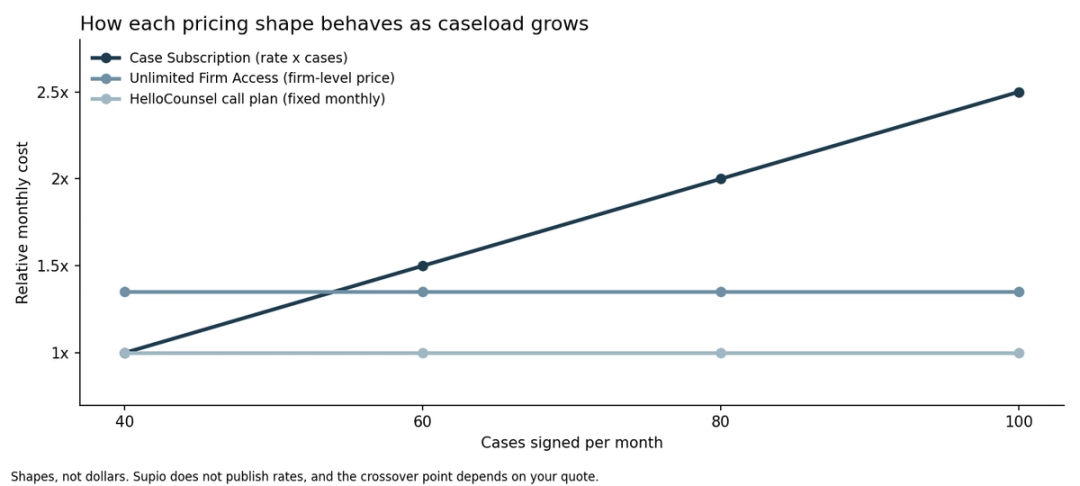
Four details shape the real Supio price more than the rate does:
- No platform or setup fees: You pay for work, not access, and setup is measured in hours rather than weeks
- No lock-in contracts: The plans are described as risk-free, so ask what notice period applies
- A pilot first: Many firms start on a handful of cases, and Supio's FAQ mentions a 10-pack bought through a sales rep
- Case Invoices: An invoice is issued on every case, so the cost can be passed through to the client, which changes what your firm absorbs more than a rate negotiation usually does
Note
Pass-through billing has to satisfy your fee agreements and your state's rules on case expenses. Check both with your own counsel before you build it into the business case.
What the Supio Case Fee Buys
The platform range is wide for what the Supio price covers. On the document side, you get medical chronologies, demand letters, litigation drafting, interrogatory responses, and Exhibit Builder, with human expert verification behind the outputs, which is part of why the unit is the case rather than the seat.
On the data side, Case Economics, Instant Ledger, missing-records flags, and Knowledge Bases sit alongside Supio Agent, cross-case analysis, and mass tort tooling at firm level. Westlaw Advantage came in through the Thomson Reuters partnership in April 2026. Integrations cover Litify, SmartAdvocate, MyCase, CASEpeer, Smokeball, Jove, and Neostella with two-way sync, and the security posture is SOC 2 Type II, HIPAA, PHIPA, and GDPR, with client data kept out of foundation model training. For the wider category, see our roundup of AI tools for PI lawyers.
Where Supio Intake Stops
Supio pricing includes the intake agents, which are the part of the platform that touches the phone. Three agents run across voice, SMS, web, and email: a voice agent that covers overflow and after-hours calls, captures details, qualifies the lead, and transfers priority cases to an attorney; a scoring agent that ranks cases; and a coaching agent that helps your team close on live calls. That is a real product, and it covers the first call well.
The calls after the first one are a different job, and no part of Supio pricing covers them.
| Call type | Covered by Supio Intake |
|---|---|
| Overflow and after-hours calls from new leads | Yes |
| Lead qualification and scoring | Yes |
| Transfer of priority cases to an attorney | Yes |
| Coaching on live intake calls | Yes |
| Status calls from existing clients | No. Supio Intake is built for new leads |
| Provider calls about records and appointments | No. Supio flags missing records and points retrieval to a partner |
| Adjuster callbacks and claim follow-up | No |
| Treatment check-ins between visits | No |
| Hold queues on provider and insurer lines | No |
As per our analysis, a typical PI case generates about 150 calls, most of them after the retainer is signed, as our breakdown of how many calls a PI case generates shows. Our guide to AI on medical provider calls covers how long the records ones take.
The Line Item Neither Plan Covers
Say four case managers each spend an hour a day on provider calls, adjuster callbacks, and status updates. That is roughly 80 hours a month. At the BLS median of $30.24 an hour for paralegals and legal assistants, those hours cost about $2,400 in wages before benefits, a line that never appears on a Supio invoice, and the figure grows with your caseload the same way a per-case rate does. Our guide to case manager workload breaks down where the time goes.
That is the work HelloCounsel prices. Our AI voice agents answer the main line, take status calls from existing clients, and place the records, treatment, and claim calls your team makes today. The price is published and fixed: from $500 a month (as of September 2026), holding within 20% of your scoped volume, with no setup fee.
HelloCounsel by the Numbers
- 25,000+ calls handled - 500+ hours of call time handled - 93% SOP precision in every call - 48% improvement in call reception rates Figures reported by HelloCounsel.
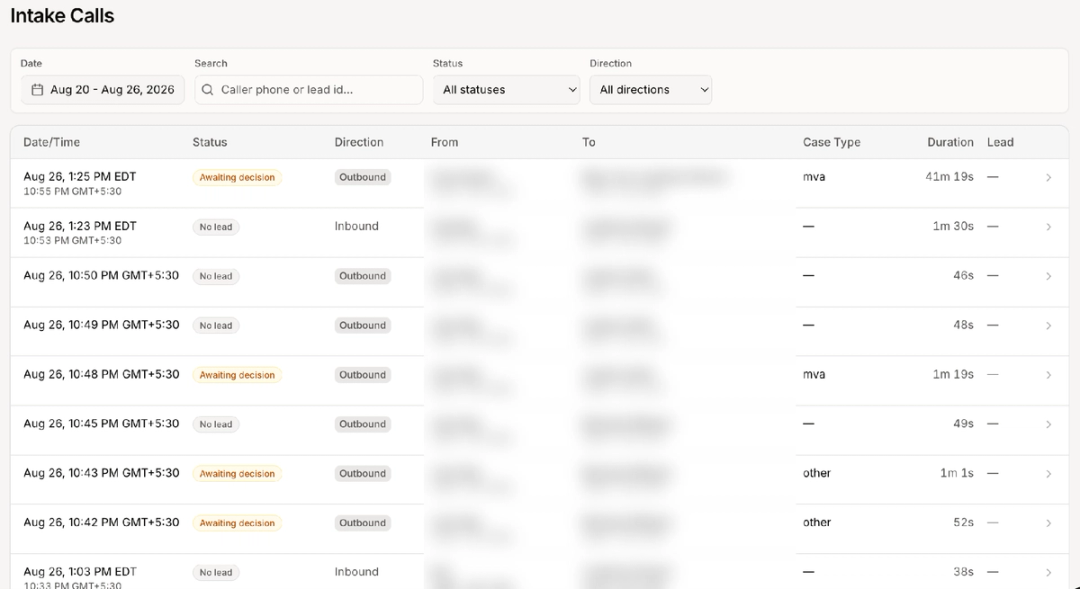
What the agents cover
- Caller pre-identification: The agent checks the caller against the case management system before handling the call, so it knows whether it is speaking with a client, provider, adjuster, or new prospect, which matter is involved, and which case staff to route to
- Custom call flows: Separate flows for new callers, current clients, providers, adjusters, attorneys, and after-hours traffic, each following your firm's SOP
- 24/7 answering: Picks up every call on the main line, including nights, weekends, holidays, and campaign spikes
- AI intake: Qualifies intake calls against your criteria in seconds and writes intake notes directly into the case management system
- Bilingual English and Spanish: Handles both languages on one line, including callers who switch mid-conversation, with no transfer
- Lead follow-up: Calls back new leads who did not sign on the first call and logs each attempt
- Case opening: Once a lead qualifies, creates the matter in your case management system, enters contact, incident, and insurance details, sends the retainer, and assigns the case to your team
- Case development: Keeps signed cases moving between intake and demand by running the routine calls each case phase creates, then closing the loop in the file when each task is done
- Medical records retrieval and organization: Organizes records requests on each new matter from day one, then works provider phone trees and hold queues, confirms request status, and repeats follow-up until the records arrive
- Medical coordination: Confirms appointments with providers, sets treatment dates from the case file, and logs referrals and schedule changes to the matter
- Treatment check-ins: Places scheduled client calls after each visit, captures updates, and escalates when the case manager needs to step in
- Client check-ins: Runs regular status calls so clients hear from the firm on a schedule, and logs anything new to the case file
- Legal coordination: Handles routine calls with adjusters and lien holders, confirms claim numbers and balances, and writes each exchange to the case file
- Insurance claim opening: Opens claims with carriers through outbound calls
- Hold-time handling: Works insurer and provider phone menus and waits in hold queues, then connects your staff when a person answers
- Task completion: Each supported call ends with the action done and the case file updated, so staff do not have to act on a forwarded message
- CMS write-back: Direct integrations with SmartAdvocate, Filevine, Litify, Lead Docket, and Clio, with custom integrations available for other systems
- Call reporting: A dashboard measures call volume, caller type, transfers, and script adherence, so you can size the phone load before and after launch
- Human escalation: Your transfer rules send sensitive, judgment-heavy, or out-of-scope calls to the right person with context loaded
"Working with HelloCounsel has been an outstanding experience. Their commitment to client service and innovation is evident in everything they do. We've been extremely impressed with our new AI receptionist, Kate, and the impact it's already making for our firm. I'm excited to continue exploring additional solutions that allow our case managers to focus more time on delivering exceptional client care." Anthony Ramos, COO, Pendergast Law
Practical Tip
Before your Supio demo, tag one week of calls by caller type: new lead, existing client, provider, adjuster, lien holder. The new-lead column is what Supio Intake covers. The rest is the column to price separately.
Supio and HelloCounsel, Side by Side
Supio pricing and HelloCounsel pricing answer different questions, because the two sit on different halves of the day. Supio turns records into chronologies, demands, and case data. HelloCounsel runs the call operation, inbound and outbound, at a published price, while Supio pricing is quoted by case.
| Capability | Supio | HelloCounsel |
|---|---|---|
| Published starting price | No. Both plans are quoted after a demo | Yes. $500 a month, fixed |
| Cost holds as you sign more cases | No on Case Subscription, yes on Unlimited Firm Access | Yes. Holds within 20% of scoped volume |
| Platform or setup fees | No. Supio states no platform fees | No. One hour-long onboarding call |
| Cost billed through to the case | Yes. Case Invoices on every case | No. HelloCounsel bills the firm directly |
| 24/7 inbound voice for new leads | Yes. Overflow and after-hours coverage | Yes. Every call, with caller pre-identification and custom call flows |
| Calls from existing clients | No. Supio Intake is built for new leads | Yes. Agents identify the client and matter and give the approved update |
| Outbound calls to providers and carriers | No | Yes. Records, treatment, and claim calls, followed up until the task closes |
| Hold-time bridge for your team's calls | No | Yes. Agents wait on hold and connect your teammate |
| Call performance reporting | No. Calls surface in case context through integrations | Yes. Volume, caller type, transfer rates, and sentiment |
| CMS integration | Yes. Two-way sync with Litify, SmartAdvocate, MyCase, CASEpeer, Smokeball, Jove, and Neostella | Yes. Write-back to the matter, direct to SmartAdvocate, Filevine, Litify, Lead Docket, and Clio, plus custom builds |
| Chronologies, demands, and firm analytics | Yes. With human expert verification | No. Drafting stays with your team or another tool |
Most firms do not choose between the two. Supio handles records, chronologies, and demands, and Supio pricing covers that work well when a high share of cases runs through the platform. The phone is a separate purchase, and if your case managers spend mornings on hold and afternoons returning status calls, that is the one to price next. The case for automating outbound calls shows how much time comes back, and a generic AI receptionist will not do it, because the call types are wrong.
Questions to Ask Supio Before You Sign
| Question | Why it matters |
|---|---|
| What is the per-case rate at our volume, on both plans? | The break-even between them depends on your case count |
| What counts as a case for billing? | It decides how much of your Supio cost is chargeable |
| At what volume does Unlimited Firm Access win? | Ask for the crossover point in writing |
| What notice period applies without a lock-in contract? | Risk-free terms still have an exit process |
| How are Case Invoices generated and itemized? | Pass-through billing has to satisfy your fee agreements |
| Does the intake voice agent take calls from existing clients? | Supio Intake is built for new leads |
| Who places provider and adjuster calls? | Outbound calling is not part of the plans |
| What does the CMS sync write back, and where? | Insights pushed back are different from call notes on the matter |
| What does the pilot cover, and what does it cost? | Most firms start on a handful of cases |
The same list works on the vendors in our guide to EvenUp alternatives, and our checklist on how to evaluate an AI voice agent covers the call side.
What reviews can and cannot tell you
Not much, in this case. Supio's G2 profile is unclaimed with no reviews, and there is no Capterra listing. What is documented is funding and adoption: a $60 million Series B in 2025, part of the plaintiff AI funding wave LawSites tracked through the year, and more than 500 plaintiff firms on the platform. With no review corpus, references do the work, so ask for firms your size running your case types, and call them.
Price the Platform and the Phones Separately
On structure, Supio pricing is clearer than most of its category: two plans, unlimited users and pages, no platform fees, and invoices you can pass to the case. The number still comes from a demo, so get both plans quoted at next year's case count and ask where the Supio cost crossover sits.
Then price the work the plans do not touch. Records follow-up, adjuster callbacks, and treatment check-ins are phone work, and they stay with your case managers until something else picks them up. Review the HelloCounsel product against the call list you tagged, or read about the team behind it.
Book a call with HelloCounsel's founders and bring that call list. The team will show you which calls the agents can take and where each outcome lands.
Frequently Asked Questions
How much does Supio cost?
Supio pricing is not published. Supio offers a Case Subscription and Unlimited Firm Access, both priced on firm size and case volume, with unlimited users and pages and no platform fees. Rates come through a demo.
How does HelloCounsel pricing compare with Supio?
HelloCounsel publishes a fixed monthly price starting at $500, scoped to your call volume. Supio prices by case, so its cost tracks your caseload on a Case Subscription and flattens on Unlimited Firm Access.
Which service handles calls after the case is signed?
HelloCounsel answers status calls from existing clients and places outbound records, treatment, and claim calls, writing each outcome to the matter. Supio Intake covers new-lead calls.
What are Supio's pricing plans?
Two. A Case Subscription priced on firm size and case volume, and Unlimited Firm Access, which offers the lowest per-case cost with unlimited cases and the widest support and training options.
Does Supio charge platform or setup fees?
No. Supio states that both plans come without platform fees or lock-in contracts, and that firms get set up in hours rather than weeks.
Can you pass Supio's cost on to clients?
Supio issues Case Invoices on every case so firms can pass the cost through. Check the arrangement against your fee agreements and your state's rules on case expenses.
Does Supio offer a pilot?
Yes. Many firms start with a pilot on a handful of cases to test the platform on their own documents before rolling it out more widely.
Share this article