
- Filevine fits high-volume PI and mass tort work best, Clio suits mixed practices that value integrations, and MyCase suits small firms that want simple pricing.
- All three changed commercially in 2026: Clio moved its mid and upper tiers behind a quote form, MyCase raised list prices, and Filevine still publishes nothing.
- Licence math decides your real budget, because case managers, paralegals, and intake staff need seats alongside the attorneys.
- None of the three is purpose-built for personal injury, so CASEpeer, SmartAdvocate, Litify, and CloudLex belong on the shortlist if PI is all you do.
- Every platform here records work rather than doing it, so provider calls, adjuster callbacks, and client updates still fall to your staff.
- HelloCounsel runs that call layer on fixed pricing from $500 a month and writes each outcome into the matter, whichever platform you choose.
Draft
A case manager should be able to say where the Alvarez records stand in about forty seconds. At most firms it takes three tabs, a spreadsheet, and a message to whoever touched the file last.
That is what sends firms looking, and Clio, Filevine, and MyCase land on almost every shortlist. Choosing between them got harder this year, because all three changed how they sell. Clio used to publish four tiers and now shows one, starting at $49 per user per month for EasyStart, with everything above it behind a quote form. MyCase raised its list prices from $39, $89, and $109 to $50, $100, and $130 per user per month on annual billing. Filevine quotes every package individually, as it always has.
The short answer on Clio vs Filevine vs MyCase: Filevine matches the way a PI case actually runs, Clio is the safer generalist with the deepest integration bench, and MyCase is the easy one to buy for a small firm. The real split is how much configuration you want to pay for before the software starts earning its keep.
How the Three Compare at a Glance
| Clio | Filevine | MyCase | |
|---|---|---|---|
| Built for | General practice, all sizes | High-volume PI, mass tort, complex litigation | Solo and small general practice |
| Published pricing | Partly. EasyStart only | No. Quote for every package | Yes. All three tiers |
| Entry price | $49 per user per month | Not published | $50 per user per month on annual billing |
| PI workflow depth | Moderate. PI product added in 2023 | Deep. Case phases and demand automation | Light |
| Intake tool | Clio Grow, priced separately | Lead Docket, priced separately | Included on Pro and above |
| API access | Higher tiers | Yes | Advanced tier only |
| Implementation | Self-serve to light | Certified partner, separate contract | Self-serve |
| Contract | Monthly or annual | Annual standard | Monthly or annual, no long-term obligation |
Where Clio Fits a PI Firm
Clio is the platform most firms can adopt without a project plan. Setup moves fast, the interface feels familiar to anyone who has used modern software, and the integration catalog is the largest in legal, which matters if your firm runs a stack rather than a single system.
For personal injury specifically, Clio launched a PI-focused product in late 2023. It handles matters, deadlines, documents, and billing well. It does not model a PI case the way a plaintiff shop thinks about one, with treatment phases, liens, records status, and demand packages as first-class objects. Firms running mixed practices tend to find that acceptable. Firms doing nothing but PI often feel the gap by the second year.
The commercial picture changed in 2026. EasyStart stays public at $49 per user per month, while Essentials, Advanced, and the top tier, renamed from Complete to Expand, now require a sales conversation. Third-party trackers report the last published figures as $89, $109, and $149 per user per month, which works as an anchor but no longer comes from Clio.
Clio also prices several pieces separately. Clio Grow, the intake CRM most PI firms want, carries its own per-user charge, and payment processing runs at standard card rates. Everyone in this category sells that way, so price the add-ons you will actually turn on, not the headline seat price.
Why Filevine Suits Plaintiff Work
Filevine started in 2014 with a personal injury attorney who could not make general project software fit a caseload. That origin still shows. Case phases, deadline chains, document assembly, and demand generation work the way a plaintiff firm works, and the customization runs deep enough that two Filevine instances at two firms can look nothing alike.
Its AI suite, LOIS, targets the bottlenecks in a PI file: medical record analysis and chronologies, document drafting grounded in matter data, and deposition intelligence. DemandsAI generates demand packages. MedChron organizes records into a timeline and surfaces gaps. For a firm processing thousands of pages of records a month, that is the strongest argument in the category.
Filevine asks for configuration in return, and it publishes no pricing at all. Capterra lists five quote-only packages, with Lead Docket sold as its own line. Implementation usually runs through a certified partner, which means a second contract and a second invoice. Third-party reports put base seats in the $49 to $87 range and totals past $150 once AI and add-ons land, with onboarding fees from $1,000 into five figures. Those are market reports rather than vendor pricing, so a line-item quote gives you the real number.
Volume decides the fit. Below roughly ten attorneys or a few hundred active matters, most firms use a fraction of what they configure.
What MyCase Does Well for Smaller Firms
MyCase is the easiest of the three to buy and the easiest to learn. Case management, billing, a client portal, two-way texting, and intake forms arrive in one interface, and the trial requires no credit card. For a four-person firm that wants to stop running cases out of email, it works on day one.
Its pricing is the most transparent in this comparison, which makes the 2026 increase easy to see. Basic, Pro, and Advanced now run $60, $120, and $150 per user per month billed monthly, or $50, $100, and $130 billed annually. Earlier in the year those tiers ran $39, $89, and $109.
MyCase places its Open API on the Advanced tier, so firms planning to connect a records vendor, a voice agent, or any other system should factor that tier in early. MyCase suits smaller PI practices and general-practice firms with some PI work. It does not offer case-phase automation, records tracking, or demand tooling, so firms often move to another platform as caseload grows.
What Each Platform Actually Costs a PI Firm
Cost is where most Clio vs Filevine vs MyCase shortlists get decided. Vendor pricing pages quote per user, and firms budget per attorney. Those are different numbers. Case managers, paralegals, and intake staff all need licences, so a practice with 4 attorneys and 11 support staff buys 15 seats rather than 4. Here is that firm at published rates, annual billing where available.
| Scenario | Per user per month | 15 seats per month | 15 seats per year |
|---|---|---|---|
| MyCase Basic | $50 | $750 | $9,000 |
| MyCase Advanced | $130 | $1,950 | $23,400 |
| Clio EasyStart | $49 | $735 | $8,820 |
| Clio mid tier, last reported at $89 | $89 | $1,335 | $16,020 |
| Filevine, third-party reported range | $49 to $87 | $735 to $1,305 | $8,820 to $15,660 plus implementation |
Only the MyCase and Clio EasyStart rows come from vendor pages. The Clio mid tier and the Filevine range come from third parties, so replace them with your own quotes.
Seat Math
The median annual wage for paralegals and legal assistants was $62,890 in May 2025, according to the Bureau of Labor Statistics. Seat licences are the small number next to the salaries of the people using them, which is why adoption matters more than the per-seat price.
The PI Workflows That Separate Them
All three handle matters, calendars, documents, and billing, so feature lists blur together. These five workflows are where they split for a plaintiff practice.
- Intake and lead capture: Filevine sells Lead Docket separately, which suits firms tracking referral sources and marketing spend against signed cases. Clio Grow does similar work as an add-on. MyCase includes intake forms on Pro, which covers a firm signing a handful of cases a month
- Case phases and treatment tracking: Filevine models a case as stages with dependencies, so a matter in treatment looks different from one in litigation and deadlines cascade automatically. Clio handles matter status and custom fields, though your firm builds the logic. MyCase offers basic status tracking
- Medical records and chronologies: Filevine's MedChron organizes records into a timeline and flags gaps, the most time-consuming task in pre-litigation. Clio and MyCase rely on document storage plus your retrieval vendor
- Demand packages: Filevine's DemandsAI drafts demands from the record set. Clio and MyCase offer no equivalent, so firms draft demands manually or buy a separate tool
- Contingency billing and case costs: PI firms track advanced costs and settlement distributions rather than billable hours. Filevine handles case costs natively, Clio manages it with configuration, and MyCase is the weakest here, as its reviewers say directly
If three or more of those describe your daily bottleneck, the Clio vs Filevine vs MyCase question has mostly answered itself, and the remaining decision is whether you want Filevine's build or a purpose-built PI platform instead.
What Users Say About Each Platform
Reviews rarely settle a Clio vs Filevine vs MyCase decision, because all three rate well. On Capterra, Clio holds 4.7, Filevine holds 4.4, and MyCase carries more than 800. What reviewers complain about is the useful part.
Clio reviewers return to cost creep and transition pain. One reviewer in May 2026 noted that the transition between products brings frustration and lost productivity, Clio included. Another described migrating at the end of December and still being unable to pull an accurate fee report by mid-February.
Two MyCase complaints matter specifically to plaintiff firms. One reviewer said the billing and invoicing are not compatible with contingency firms, a structural mismatch rather than a preference. The same reviewer asked MyCase to integrate with a VoIP phone system such as RingCentral so the firm could automate some of its calling procedures, which describes work a case management system does not cover.
Filevine's reviewer base skews toward personal injury, mass tort, and litigation, and the praise centers on customization and document generation. The criticism centers on the same thing from the other side: the build takes time, and firms that under-invest in configuration get less out of it.
How Long the Migration Really Takes
Vendors quote a go-live date. In practice, teams keep working around the old system for a while after it, whichever way the Clio vs Filevine vs MyCase call goes.
MyCase moves fastest, because there is less to configure, and most small firms run within days on a 10-day trial that covers enough to test it properly. Clio sits in the middle, with a self-serve path for small firms and partner-assisted migration for larger ones. Filevine is a project. Configuration usually runs through a certified implementation partner, and the build reflects decisions your firm makes first: case phases, custom fields, document templates, and who owns each stage.
Three costs come up across all three platforms. Data migration rarely arrives clean, so someone spends weeks reconciling matters, contacts, and documents. Training competes with billable work, so adoption lags the go-live date. The old system also runs in parallel longer than planned, so you pay twice for a quarter. Ask each vendor who performs the migration, what it costs, and what your firm supplies, before the contract rather than after.
Which One Fits Your Firm
| If this describes you | Look at |
|---|---|
| PI or mass tort, high volume, willing to fund configuration | Filevine |
| Mixed practice with PI as one piece, integration-heavy stack | Clio |
| Small firm, cost-sensitive, wants to be live this month | MyCase |
| PI only, want workflows out of the box without Filevine's build | CASEpeer, SmartAdvocate, or CloudLex |
| Multi-office plaintiff firm already on Salesforce | Litify |
| Planning to connect several systems by API | Skip MyCase Basic and Pro, since the API sits on Advanced |
Of those three, only Filevine started with plaintiff work. If PI is your whole practice and you do not want a configuration project, give the purpose-built systems a demo before you commit.
What the Migration Fixes, and What It Leaves Alone
A switch does deliver. Your matters get organized, deadlines move out of individual inboxes, and you finally get reporting you can hand a partner.
The phone stays where it was. As per our analysis, a typical personal injury case generates about 150 calls over its life, and most land after the client signs: the records coordinator at the orthopedic group, the adjuster returning a call at 4 p.m., the client three weeks into physical therapy who wants to know what happens next. Our breakdown of how many calls a PI case generates shows the mix. None of the three platforms places those calls or answers them.
They record the calls when someone types the note, so the file reflects whatever the team captures at the end of a busy day, which is why call history is usually the thinnest part of a matter and how a documentation problem starts.
Worth Checking
A case management system organizes work your team has already done. The hours themselves go to hold queues and callbacks, which is where case manager workload builds up.
Where HelloCounsel Fits, Whichever Platform You Pick
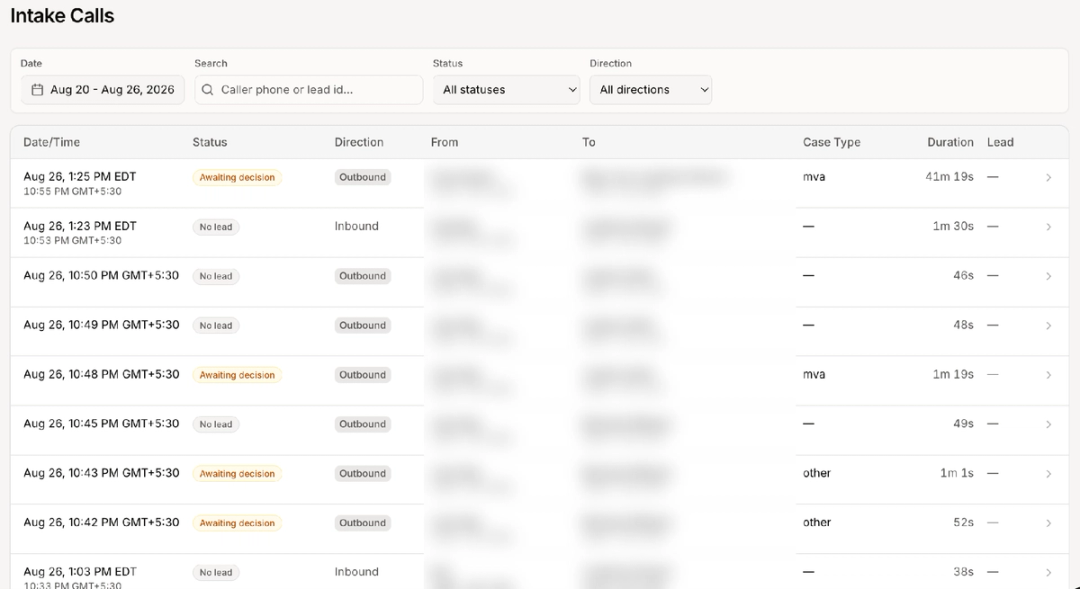
HelloCounsel handles the call layer that sits on top of your case management system. Our agent, Counsel, answers the main line, identifies whether the caller is a client, an adjuster, or a provider, and routes by case phase. It also places the outbound calls a case generates: chasing records through provider phone trees, checking in with clients after treatment visits, which keeps client communication steady, and waiting in insurer hold queues so a paralegal does not have to. The case for automating outbound calls covers that side in detail.
What the agents cover
- Caller pre-identification: The agent checks the caller against the case management system before handling the call, so it knows whether it is speaking with a client, provider, adjuster, or new prospect, which matter is involved, and which case staff to route to
- Custom call flows: Separate flows for new callers, current clients, providers, adjusters, attorneys, and after-hours traffic, each following your firm's SOP
- 24/7 answering: Picks up every call on the main line, including nights, weekends, and campaign spikes
- AI intake: Qualifies intake calls against your criteria in seconds and writes intake notes directly into the case management system
- Bilingual English and Spanish: Handles both languages on one line, including callers who switch mid-conversation, with no transfer
- Lead follow-up: Calls back new leads who did not sign on the first call and logs each attempt
- Medical records retrieval: Works provider phone trees and hold queues, confirms request status, and repeats follow-up until the records arrive
- Treatment check-ins: Places scheduled client calls after each visit, captures updates, and escalates when the case manager needs to step in
- Insurance claim opening: Opens claims with carriers through outbound calls
- Hold-time handling: Works insurer and provider phone menus and waits in hold queues, then connects your staff when a person answers
- Task completion: Each supported call ends with the action done and the case file updated, so staff do not have to act on a forwarded message
- CMS write-back: Direct integrations with SmartAdvocate, Filevine, Litify, Lead Docket, and Clio, with custom integrations available for other systems
- Call reporting: A dashboard measures call volume, caller type, transfers, and script adherence, so you can size the phone load before and after launch
- Human escalation: Your transfer rules send sensitive, judgment-heavy, or out-of-scope calls to the right person with context loaded
Every call ends with notes, fields, and a summary written into the matter, which is the part that survives staff turnover. We have direct integrations with SmartAdvocate, Filevine, Litify, Lead Docket, and Clio. MyCase runs as a custom integration, scoped during onboarding, and the same is true of other systems outside that list. The mechanics of CMS write-back explain what lands in the file and when.
HelloCounsel by the Numbers
- 25,000+ calls handled - 500+ hours of call time handled - 93% SOP precision in every call - 48% improvement in call reception rates Figures reported by HelloCounsel.
"Working with HelloCounsel has been an outstanding experience. Their commitment to client service and innovation is evident in everything they do. We've been extremely impressed with our new AI receptionist, Kate, and the impact it's already making for our firm. I'm excited to continue exploring additional solutions that allow our case managers to focus more time on delivering exceptional client care." Anthony Ramos, COO, Pendergast Law
Pricing starts at $500 a month and stays fixed, with no per-minute or per-call billing, so a marketing push does not change the invoice. Firms already on Filevine can see how this works in our roundup of AI voice agents for Filevine users, with equivalent breakdowns for Litify firms and SmartAdvocate intake.
A Short Buying Process That Avoids the Usual Regrets
Firms that stay happy with their choice tend to run the same five steps.
1. Name the bottleneck: Write down the five workflows above and mark which ones hurt today. That list, not a feature grid, decides the shortlist
2. Run a real matter: Ask the sales engineer to build your intake form, move a case from treatment into litigation, and produce the report your managing partner asks for every Monday
3. Get line-item quotes: Cover seats, add-ons, implementation, and renewal terms, and count every person who needs access
4. Ask about exit: Check how data export works if you leave, since terms vary between vendors
5. Ask what stays manual: The answer shows how much work continues after the migration, and our checklist on how to evaluate an AI voice agent covers the call side of it
Buy the System of Record on Workflow, Then Solve the Phone
The Clio vs Filevine vs MyCase decision comes down to how closely you want the software to match a plaintiff caseload, and how much configuration you will fund to get there. Filevine fits closest and asks the most from you. Clio asks the least and fits loosely. MyCase asks almost nothing and fits least.
Get line-item quotes from all three, count every seat including support staff, and ask each vendor what implementation involves, including who does it and what it costs. Intake, payments, and onboarding can move a quote that looked $30 a seat cheaper into the more expensive column.
Then look at the work still waiting on Monday morning. The platform holds your matters. It will not call the records department, and it will not tell a client why her case has been quiet for three weeks. If most of that work is calls, HelloCounsel runs it on fixed monthly pricing and writes the outcome into whichever platform you chose. Review the HelloCounsel product against a week of your own calls.
Book a call with the HelloCounsel founders and bring that week of call logs. The team will set up a two-week pilot and show you how much of it never needed a person.
Frequently Asked Questions
Which is better for personal injury: Clio, Filevine, or MyCase?
Filevine, for most PI firms. Its case phases, document automation, and medical record tooling match plaintiff workflows. Clio suits mixed practices, and MyCase suits small firms that need simplicity over depth.
How much does Clio cost in 2026?
Clio publishes one price: EasyStart, starting at $49 per user per month. Essentials, Advanced, and Expand require a quote. Third-party trackers last reported those tiers at $89, $109, and $149.
Does Filevine publish pricing?
No. Filevine custom-quotes every package and prices Lead Docket separately. Implementation typically runs through a certified partner under its own contract, so ask for a line-item quote covering both.
Is MyCase good for personal injury firms?
MyCase works for small PI firms that want simple case management and billing. It lacks case-phase automation, records tracking, and demand tooling, so higher-volume practices usually outgrow it.
Which case management systems does HelloCounsel integrate with?
HelloCounsel has direct integrations with SmartAdvocate, Filevine, Litify, Lead Docket, and Clio. The team builds custom integrations for other systems, including MyCase, and scopes them during onboarding.
Who handles the calls a case generates after the migration?
Your staff, unless you add a call layer. HelloCounsel answers the main line, runs records follow-up and treatment check-ins, and writes each outcome into your case management system.
What should we ask vendors before signing?
Ask for a line-item quote, total seats including support staff, implementation cost and owner, API access by tier, data migration scope, and renewal terms. Those six answers explain most of the price difference.
Share this article