
- Scope first: Supio now spans intake, case preparation, litigation, and firm intelligence, so the right Supio alternative depends on which part of that work you want off your team.
- HelloCounsel: HelloCounsel is the Supio alternative for PI firms whose bottleneck is calls, answering the main line, handling intake, and running outbound follow-up after signing.
- Closest broad platforms: EvenUp and EveOS overlap most with Supio across demands, casework, intake, and outbound communication agents.
- CMS-centered options: Filevine LOIS and SmartAdvocate SmartIntelligence fit firms that want AI inside their case management system.
- Narrow demand option: Precedent focuses on demands and claim setup at a flat $275 per demand.
- Pricing: HelloCounsel plans start at $500 per month with no per-minute billing, while most broad plaintiff AI platforms require a sales quote.
- Decision rule: Compare Supio competitors on the work each one finishes, source traceability, CMS behavior, and what their users report after implementation.
Supio now covers a PI matter from intake through litigation. In May 2026 it launched Supio Agent, which spans case preparation and firm intelligence, and Supio Intake, which answers after-hours and overflow intake calls. Most firms comparing Supio alternatives are replacing one slice of that platform, so the first decision is which slice.
A firm buying for demand output should look at different Supio competitors than a firm buying for CMS-native AI or relief from phone work. For PI firms whose case managers spend the day on status calls, provider follow-up, and adjuster callbacks, the slice that matters most is the call operation, which is where HelloCounsel leads this list.
Our Top Picks at a Glance
- HelloCounsel: Best for PI firms whose bottleneck is inbound calls and post-signature call operations.
- EvenUp: Best for demand drafting, negotiation, and a broad pre-litigation workflow.
- EveOS: Best for a broad plaintiff AI operating system across intake, casework, and firm analytics.
- Filevine LOIS: Best for firms already on Filevine that want AI agents inside the system of record.
- Precedent: Best for demand-first teams that want a flat per-demand price.
- SmartAdvocate SmartIntelligence: Best for firms that want AI intake, chronologies, and demands inside a PI case management platform.
Why PI Firms Compare Supio Alternatives
Supio's wider scope has removed some reasons to switch, and four practical ones remain. Each one points to a different category of Supio alternative.
You only need one workflow
A demand backlog rarely justifies a platform that also covers litigation and firm analytics. A narrower Supio alternative is faster to adopt and easier to price against the one problem you have.
Your CMS is already the center of the stack
If Filevine or SmartAdvocate runs the firm, the best Supio alternative may be the AI built into that system, which avoids another sync, another login, and another adoption project for your case team.
You want a different pricing model
Supio lists two pricing structures, Case Subscription and Unlimited Firm Access, without dollar amounts. A Supio alternative with a flat per-demand price or a published starting price is easier to model before the first sales call.
Your real bottleneck is calls, not documents
Supio Intake focuses on new leads: after-hours and overflow answering, lead scoring, and staff coaching. Most PI call volume arrives after the client signs, from existing clients, providers, adjusters, and lien holders. By HelloCounsel's estimate, a typical PI case generates about 150 calls over its life, which is why how many calls a PI case generates should shape this evaluation. Each of those calls that goes to voicemail adds to the hidden cost of missed calls.
How We Ranked These Supio Alternatives
We ranked each Supio alternative on fit for a mid-market plaintiff firm, using the same six criteria for every entry. For a wider view beyond Supio competitors, see our list of top AI tools for personal injury lawyers.
| Criterion | What we checked |
|---|---|
| Plaintiff specificity | Whether the product models PI records, treatment, damages, case phases, and plaintiff intake |
| Work completed | Whether the product finishes a task or hands a message or draft back to staff |
| Source traceability | Whether a lawyer can verify where a medical fact, case fact, or legal authority came from |
| CMS behavior | Whether results land in the system of record or create another place staff must maintain |
| User feedback | What verified reviews on Capterra and G2 report about setup, support, and daily use |
| Human oversight | Which outputs staff review and which calls or decisions route to a person |
Worth Knowing
In the ABA 2024 AI TechReport, 30.2 percent of attorneys said their offices used AI-based tools, and the rate was 29.5 percent at firms with 10 to 49 lawyers. Mid-sized plaintiff firms are choosing between AI products now, not deciding whether to try one.
The 6 Best Supio Alternatives for PI Firms Compared
Three questions split Supio alternatives fastest: does the product answer your main line, does it draft demands, and is its pricing published?
| Platform | Answers the main line | Drafts demands | Published pricing |
|---|---|---|---|
| HelloCounsel | Yes. Answers every inbound call and runs outbound follow-up after signing | No. Focused on call operations | Yes. Plans start at $500 per month |
| EvenUp | Not listed. Communication Agents place outbound voice and text follow-ups | Yes. AI and professionally reviewed demands | No. Case-based quote |
| EveOS | Yes, for intake. Jenny answers intake calls 24/7 in 28 languages | Yes. Agents draft demands for attorney review | No. Custom quote |
| Filevine LOIS | Not listed. LOIS runs agents on matter work | Yes. DemandsAI inside Filevine | No. Custom quote |
| Precedent | Not listed. Focused on claim setup and demands | Yes. Demand Composer with unlimited revisions | Yes. $275 flat rate per demand |
| SmartAdvocate SmartIntelligence | Yes, for intake. Intake AI Voice Agent engages prospective clients | Yes. Demand drafts inside the CMS | No. Custom quote |
1. HelloCounsel: Best for PI call operations from intake to follow-up
Best for: Plaintiff firms whose case managers and intake teams spend the day on inbound calls and post-signature follow-up.
HelloCounsel is the Supio alternative built for PI, workers' comp, and mass tort call operations. Its agents answer the main line, handle intake, and place the outbound calls that keep a case moving after signing, including records requests, treatment check-ins, and claim openings. Each outcome is written into your case management system, so the file shows what happened without a staff member typing it in. Provider calls are where most case teams feel the load first, which is why we cover AI on medical provider calls separately.
Among Supio alternatives, HelloCounsel is the only product here built solely around the phone. Supio, EveOS, and SmartAdvocate answer intake calls, and EvenUp runs outbound follow-ups, but each treats calls as one module in a larger platform. HelloCounsel answers every caller type on the main line and finishes the work those calls create, which is the most direct way to reduce case manager workload.
#### Key features
- Caller pre-identification: The agent checks the caller against the case management system before handling the call, so it knows whether it is speaking with a client, provider, adjuster, or new prospect, which matter is involved, and which case staff to route to
- Custom call flows: Separate flows for new callers, current clients, providers, adjusters, attorneys, and after-hours traffic, each following your firm's SOP
- 24/7 answering: Picks up every call on the main line, including nights, weekends, and campaign spikes
- AI intake: Qualifies intake calls against your criteria in seconds and writes intake notes directly into the case management system
- Bilingual English and Spanish: Handles both languages on one line, including callers who switch mid-conversation, with no transfer
- Lead follow-up: Calls back new leads who did not sign on the first call and logs each attempt
- Medical records retrieval: Works provider phone trees and hold queues, confirms request status, and repeats follow-up until the records arrive
- Treatment check-ins: Places scheduled client calls after each visit, captures updates, and escalates when the case manager needs to step in
- Insurance claim opening: Opens claims with carriers through outbound calls
- Hold-time handling: Works insurer and provider phone menus and waits in hold queues, then connects your staff when a person answers
- Task completion: Each supported call ends with the action done and the case file updated, so staff do not have to act on a forwarded message
- CMS write-back: Direct integrations with SmartAdvocate, Filevine, Litify, Lead Docket, and Clio, with custom integrations available for other systems
- Call reporting: A dashboard measures call volume, caller type, transfers, and script adherence, so you can size the phone load before and after launch
- Human escalation: Your transfer rules send sensitive, judgment-heavy, or out-of-scope calls to the right person with context loaded
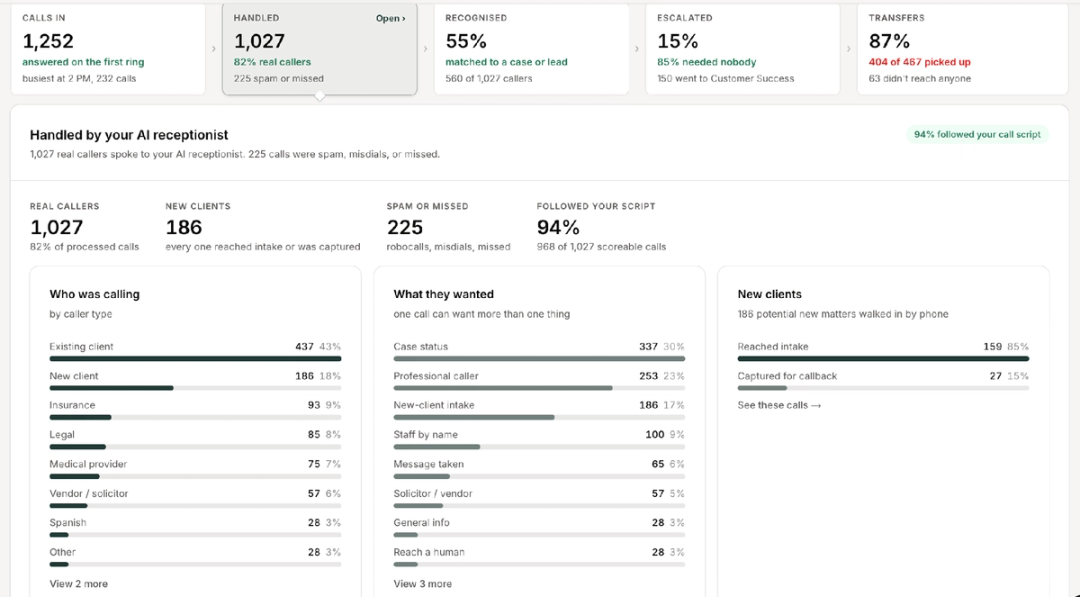
Caption: HelloCounsel dashboard (demo mode): one week of calls split by caller type and reason, with new-client calls tracked to intake or callback.
What changes for your team
- Faster speed to answer: Calls are picked up immediately, including nights, weekends, and campaign spikes
- Shorter intake: Qualification happens during the call, and intake notes reach the file without re-entry
- Automated check-ins: Treatment and status calls run on schedule without a case manager dialing each one, which keeps client communication on schedule
- Workflows carried through: Agents work inside your existing case management system and finish supported tasks
- Lower overhead: Routine call volume stops pulling paralegals and case managers off case work
HelloCounsel by the Numbers
- 25,000+ calls handled - 500+ hours of call time handled - 93% SOP precision in every call - 48% improvement in call reception rates Figures reported by HelloCounsel.
Pricing
HelloCounsel does not bill by the minute. Plans start at $500 per month (pricing as of September 2026), scoped to your call volume and licences, with a fixed monthly price that holds within a 20 percent usage tolerance and no setup fee. A campaign spike does not raise the bill.
Pros and cons
- Pros: Answers every caller type on the main line, covers intake and post-signature outbound calls in one product, writes outcomes into the case file, measures call performance, and publishes a starting price
- Cons: Does not draft demands or medical chronologies, so firms that need document AI pair it with a case-prep tool, and it is built for plaintiff firms with case managers rather than general practice
"Working with HelloCounsel has been an outstanding experience. Their commitment to client service and innovation is evident in everything they do. We've been extremely impressed with our new AI receptionist, Kate, and the impact it's already making for our firm. I'm excited to continue exploring additional solutions that allow our case managers to focus more time on delivering exceptional client care." Anthony Ramos, COO, Pendergast Law
Because HelloCounsel writes into Filevine and SmartAdvocate, it can run alongside LOIS or SmartIntelligence. Litify firms can compare the best AI receptionists for Litify, and every firm can see how HelloCounsel stacks up against other AI voice agents for personal injury firms.
2. EvenUp: Best for demand and pre-litigation workflows
Best for: PI firms that want demand, medical, negotiation, and pre-litigation automation at scale.
Of all the Supio alternatives here, EvenUp overlaps most with Supio on casework. Its platform covers AI-generated and professionally reviewed demands, medical management, negotiation support, and settlement data. In January 2026 it launched Communication Agents, AI voice and text assistants that open claims, confirm coverage, check treatment status, request records, and verify balances. Firms weighing it can also compare EvenUp alternatives.
Key features
- Demand options: Instant AI drafts or demands with professional human review
- Medical management: Treatment timelines that flag gaps, missed visits, and missing bills
- Communication Agents: Outbound voice and SMS follow-ups to carriers, providers, and clients, including Spanish
- Negotiation support: Case data connected to settlement preparation
Pricing
EvenUp uses all-in-one, case-based pricing without published dollar amounts. Request quotes from EvenUp and Supio on the same case volume and product scope.
Pros and cons
- Pros: Deep PI specialization, a mature demand workflow, and outbound agents built into the same platform
- Cons: G2 lists no user reviews for EvenUp as of September 2026, so buyers have little independent feedback to check claims against; Communication Agents launched in January 2026 and focus on outbound follow-up rather than answering the main line; and reviewed demands add a human step that lengthens turnaround
3. EveOS: Best for a broad plaintiff AI operating system
Best for: Plaintiff firms that want one AI environment across intake, casework, research, and firm analytics.
Eve launched EveOS on June 11, 2026, adding four products at once. Its intake agent, Jenny, answers calls 24/7 in 28 languages and can send engagement letters before the call ends. Auditor reviews every active matter nightly, agents draft demands and discovery responses for attorney review, and Analyst answers firm-level questions in plain English. Like Supio, it aims to be the operating layer for a plaintiff firm, so the choice between these two Supio competitors turns on workflows, integrations, and implementation effort.
Key features
- Eve Intake: 24/7 intake calls in 28 languages, with signing during the call
- Auditor: Nightly review that flags missed injuries, treatment gaps, and missing documentation
- Agents: Draft demands, discovery responses, and motions, and handle records chasing and routine calls
- Analyst: Plain-English reporting on revenue, settlements, and case distribution
Pricing
Eve does not publish pricing. Compare a written quote against Supio on the same users, cases, workflows, and contract terms.
Pros and cons
- Pros: Broad plaintiff scope, multilingual intake with in-call signing, and proactive case review across the caseload
- Cons: Four major products shipped in one June 2026 release, so firms take on a large change-management project at once; Eve also serves employment, medical malpractice, and disability firms, which spreads roadmap focus beyond PI; and third-party review summaries cite slowdowns when processing large record volumes
4. Filevine LOIS: Best if Filevine is your system of record
Best for: PI firms on Filevine that want AI agents and demand drafting without a separate case-intelligence platform.
Filevine launched the LOIS console on June 2, 2026. LOIS runs AI agents across matters and writes results back into Filevine, setting tasks, moving deadlines, updating calendars, generating documents, and running reports. DemandsAI drafts demand letters from Filevine data. As a Supio alternative, LOIS wins on architecture, since your case data and AI share one platform. Filevine firms comparing call automation can see the best AI voice agents for Filevine users.
Key features
- LOIS console: Agents that work across every matter and act inside Filevine
- Write-back: Tasks, deadlines, calendars, contacts, and reports updated in the system of record
- DemandsAI: Demand drafting from Filevine matter data
- Document analysis: Large claim files sorted to the pages that matter
Pricing
Filevine uses custom pricing, and a full Filevine plus LOIS deployment requires a tailored quote.
Pros and cons
- Pros: Native access to case data, agents that act inside the CMS, and one vendor for case management and AI
- Cons: Capterra reviewers rate value for money lowest among Filevine's scores, and several describe heavy setup and customization effort; others report inconsistent support and rigid contracts, and firms on another CMS face a full platform migration
5. Precedent: Best for flat-rate demand pricing
Best for: PI firms whose Supio use is mainly demand drafting and claim setup.
Precedent's Demand Composer drafts demand letters from case data, with unlimited pages and regenerations at a $275 flat rate. The platform also verifies coverage, sets up claims, sends letters of representation, and flags missing documentation before a demand goes out. For a firm that only needs the demand outcome, it is the simplest of these Supio competitors to test, and firms comparing demand tools can also review CaseGen AI alternatives.
Key features
- Demand Composer: Demand packages built from case data in firm-style frameworks
- Unlimited revisions: Pages and regenerations included at no extra cost
- Claim setup: Coverage verification, letters of representation, and policy limits
- Case Intelligence: Reviews documents and flags what is missing or strong
Pricing
Precedent advertises a $275 flat rate per demand letter (pricing as of September 2026).
Pros and cons
- Pros: A published price, unlimited revisions, and claim setup before the demand stage
- Cons: Per-demand pricing grows with every demand, so high-volume firms should model annual cost; the product does not answer calls, handle intake, or cover litigation, so it replaces only part of Supio
6. SmartAdvocate SmartIntelligence: Best for AI inside a PI CMS
Best for: Firms on SmartAdvocate, or firms ready to make a PI case management platform the center of their AI plan.
SmartAdvocate introduced SmartIntelligence in August 2026. It adds an Intake AI Voice Agent that engages prospective clients and logs leads, an Intake Assistant Coach, medical chronology generation, demand letter drafts, communication assistance, and predictive analytics. For existing customers, SmartIntelligence is the Supio alternative that needs no new vendor, provided the built-in AI covers enough of the work. SmartAdvocate firms focused on intake can also review the best AI intake assistants for SmartAdvocate.
Key features
- Intake AI Voice Agent: Engages prospective clients, collects case details, and logs leads
- Intake Assistant Coach: Guides staff during live intake calls
- Medical chronologies: Searchable, hyperlinked timelines with treatment data written into SmartAdvocate
- Demand drafts: Built from medical chronologies, police reports, and case notes
Pricing
SmartAdvocate pricing is tailored to each firm. Existing customers should price SmartIntelligence as an added capability rather than as a standalone Supio substitute.
Pros and cons
- Pros: AI embedded in a mature PI case management system, with less data movement for SmartAdvocate firms
- Cons: Capterra reviewers describe a steep learning curve and a cluttered interface for new staff; SmartIntelligence is new as of August 2026, its voice agent focuses on prospective clients, and firms on another CMS face switching costs
How Supio Intake and HelloCounsel Voice Coverage Compare
Several Supio alternatives answer calls, and a generic AI receptionist is rarely built for provider and adjuster calls. Here is how HelloCounsel and Supio Intake cover a PI firm's phone load.
| Call workflow | HelloCounsel | Supio Intake |
|---|---|---|
| Answers every call on the main line | Yes. Answers each caller, day or night, and routes by case phase | No. Answers after-hours and overflow intake calls |
| Qualifies new leads | Yes. Qualifies intake calls against your criteria in seconds | Yes. Scoring Agent rates leads against firm criteria |
| Writes intake notes to the CMS | Yes. Writes notes and outcomes to the case file at call end | Yes. Sends structured intake data to the CMS |
| Handles existing-client calls | Yes. Identifies the client and resolves supported requests | Not listed in Supio Intake materials |
| Verifies providers and adjusters | Yes. Confirms the caller and logs the exchange to the matter | Not listed in Supio Intake materials |
| Runs outbound records follow-up | Yes. Calls providers until records are confirmed | Not listed in Supio Intake materials |
| Runs treatment check-ins | Yes. Calls clients after each scheduled visit | Not listed in Supio Intake materials |
| Measures call performance | Yes. Tracks volume, caller type, transfers, and script adherence | Yes. Report cards and summaries for intake staff |
Alt text: HelloCounsel call log with callers tagged as client, new client, vendor, legal, insurance, and medical
Caption: HelloCounsel call log (demo mode): every call is tagged by caller type, so provider, insurer, and client calls are handled separately from new leads.
Common Mistake
Buying an intake voice agent to fix case manager workload. Intake agents qualify new leads, while most case manager calls come from existing clients, providers, and adjusters. Map your call types by caller before you compare vendors.
How to Choose the Right Supio Alternative
Start with the bottleneck, then pick the category of Supio alternative. This keeps you from paying for a broad platform when a focused tool would clear the backlog.
| If your firm | Choose | Why |
|---|---|---|
| Has case managers buried in calls | HelloCounsel | Agents answer the main line, handle intake, run post-signature follow-up, and write each result into the case file |
| Wants the closest broad PI platform | EvenUp or EveOS | Both overlap heavily with Supio across casework and AI agents |
| Runs Filevine and wants fewer vendors | Filevine LOIS | AI agents and the system of record stay together |
| Mostly needs faster demands at a known price | Precedent | Flat per-demand rate with claim setup included |
| Runs SmartAdvocate and wants built-in AI | SmartAdvocate SmartIntelligence | Chronologies, demands, and intake voice sit inside the CMS |
| Needs document AI and full call coverage | A case-prep tool plus HelloCounsel | Each layer does its own job, and both write into the same CMS |
If calls are the bottleneck, separate reception volume from post-signature work first. The difference between an AI receptionist and a virtual receptionist and the case for automating outbound calls both help size that split.
Alt text: HelloCounsel intake call log showing inbound and outbound calls with lead status, case type, and duration
Caption: HelloCounsel intake log (demo mode, caller details blurred): inbound and outbound intake calls tracked by status and case type.
Verify Output, Security, and Oversight Before You Sign
Every Supio alternative on this list touches medical records, client conversations, or both, and your lawyers still own the work product. ABA Formal Opinion 512 says lawyers using generative AI must consider competence, confidentiality, communication, supervision, candor, and fees.
In procurement terms, confirm what data each tool sees, how output is sourced and checked, who reviews it, and what a lawyer approves before anything reaches a client, carrier, or court. For call products, every call should land in the file, since an unlogged call becomes a documentation problem when a client disputes what they were told. Ask each vendor to show CMS write-back on a live test call.
Did You Know
Accuracy was a major AI concern for 75 percent of respondents in the ABA 2024 Legal Technology Survey, and for 81 percent at firms with 10 to 49 attorneys, as summarized by the Maryland State Bar Association.
Run every Supio alternative pilot on one real, difficult case. Use the same medical record set, intake edge case, or call type with each vendor, and measure revision time, missing facts, source traceability, and the cleanup your staff still performs. Our guide on how to evaluate an AI voice agent lists the call tests to run.
Which Supio Alternative Fits Your Firm?
Name the workflow, then pick among Supio alternatives. EvenUp and EveOS are the closest broad platforms, Filevine LOIS and SmartAdvocate SmartIntelligence fit CMS-centered firms, and Precedent fits a demand-only need at a flat rate.
For most mid-market PI firms, the heavier load sits on the phones. If your case managers spend their day on status calls, provider follow-up, and adjuster callbacks, HelloCounsel takes that work and writes each result into your case management system, starting at $500 per month. Slow callbacks are also a common reason firms lose cases before signing. Review the HelloCounsel product against your own call types.
Book a workflow review with the HelloCounsel founders and bring one week of call categories. The team will show you which calls the agents can take over and how each result lands in your case file.
Frequently Asked Questions
What are the best Supio alternatives in 2026?
HelloCounsel is the top pick for PI firms whose bottleneck is calls. EvenUp and EveOS are the closest broad platforms, Filevine LOIS and SmartAdvocate SmartIntelligence suit CMS-centered firms, and Precedent suits demand-only needs.
Which Supio alternative handles inbound and outbound follow-up calls?
HelloCounsel answers every inbound call, handles intake, and places outbound follow-up calls for leads, provider records, treatment check-ins, and insurance claims. It keeps calling until each task closes and writes the outcome into the case management system.
Does Supio answer phone calls?
Yes. Supio Intake answers after-hours and overflow intake calls and scores leads. HelloCounsel answers every call on the main line, including existing-client, provider, and adjuster calls, and runs outbound follow-up.
How much does Supio cost?
Supio lists two pricing structures, Case Subscription and Unlimited Firm Access, without dollar amounts. Both include unlimited users and pages, and a sales quote sets the price.
How much does HelloCounsel cost?
HelloCounsel plans start at $500 per month with no per-minute billing. The price is fixed monthly, scoped to call volume and licences, holds within a 20 percent usage tolerance, and has no setup fee.
What is the best Supio alternative for demand letters only?
Precedent is a strong narrow option, with a $275 flat rate per demand, unlimited revisions, and claim setup. EvenUp suits firms that want demands inside a broader pre-litigation platform.
Can a firm use Supio and HelloCounsel together?
Yes. Supio can handle case-prep intelligence while HelloCounsel answers the main line and runs post-signature outbound follow-up. Both write into the case management system, so the file stays complete.
Share this article