
- HelloCounsel: In the HelloCounsel vs Nexa decision, HelloCounsel fits plaintiff firms that want AI agents to answer every call, handle intake, and finish the outbound case work that follows, with each outcome written into the case file.
- Nexa: Nexa fits firms that want live receptionists covering phone, chat, and text across one outsourced front desk.
- Shared ground: Both vendors cover 24/7 answering, legal intake, English and Spanish, and outbound calls.
- Deciding line: HelloCounsel runs PI case work such as medical records retrieval, treatment check-ins, and claim opening, while Nexa's outbound work centers on reminders, follow-ups, and sales campaigns.
- Pricing: HelloCounsel vs Nexa pricing differs at the meter. Nexa bills receptionist work time in whole minutes, including hold time and after-call work. HelloCounsel starts at $500 per month with no per-minute billing.
- Integrations: HelloCounsel writes directly into SmartAdvocate, Filevine, Litify, Lead Docket, and Clio, and builds custom integrations for other systems.
- Decision rule: Choose based on the work your team still does after each call, since answering is only the first step.
Nexa puts a live receptionist on your line. HelloCounsel puts AI agents on your line and on the calls your case team places after intake. For a PI firm, the HelloCounsel vs Nexa decision comes down to one question: who finishes the work each call creates?
Your intake team is rarely the only group on the phone. Existing clients call for status, providers call about bills, adjusters return calls at 4 p.m., and records departments keep staff on hold. HelloCounsel is built to take that load off your case team, while sensitive calls still reach a person.
HelloCounsel vs Nexa at a Glance
| Criteria | HelloCounsel | Nexa |
|---|---|---|
| Built for plaintiff firms | Yes. Built for PI, workers' comp, and mass tort firms | No. Serves legal alongside home services, healthcare, and other industries |
| AI agents on calls | Yes. AI agents answer and escalate to your staff by your rules | Yes, alongside live staff. Nexa's terms allow AI agents, and clients can opt out |
| Live human receptionists | No. Your transfer rules decide which calls reach your own staff | Yes. Live virtual receptionists are central to the service |
| 24/7 answering | Yes. Answers every call on the main line, day or night | Yes. Around-the-clock answering |
| Caller pre-identification | Yes. Matches the caller to a case or lead before handling the call | No. The receptionist collects caller details during the call |
| Legal intake | Yes. Qualifies calls against your criteria in seconds | Yes. Intake and lead qualification |
| English and Spanish | Yes. Handles mid-call language switches on one line | Yes. Bilingual receptionists |
| Chat and text | No. Focused on voice | Yes. Live chat and text messaging |
| Outbound calls | Yes. Lead, client, and case-operation follow-up | Yes. Follow-ups, reminders, and outbound sales |
| Medical records retrieval | Yes. Calls providers until records are confirmed | Not listed as a PI records workflow |
| Treatment check-ins | Yes. Scheduled client calls after each visit | Not listed |
| Insurance claim opening | Yes. Opens claims with carriers | Not listed |
| Writes call outcomes to the case file | Yes. Direct write-back plus custom integrations | Yes, through CRM and practice management integrations |
| Measures call performance | Yes. Tracks volume, caller type, transfers, and script adherence | Yes. Call data and reporting through its portal |
| Per-minute billing | No. Fixed monthly price from $500 per month | Yes. Receptionist work time billed in whole minutes |
In HelloCounsel vs Nexa terms, if your case managers are the bottleneck, HelloCounsel takes on the calls that follow intake. If your gap is a staffed front desk across phone, chat, and text, Nexa covers that.
What Happens After the Call Decides This Comparison
A traditional answering service is judged at the front door: did someone answer, take the name, book the consult, transfer the call. A plaintiff firm's heaviest phone load sits behind that door, in provider records calls, treatment questions, adjuster callbacks, and insurer hold queues. HelloCounsel is built around that work and keeps people on exceptions, legal judgment, and conversations that belong with the firm.
HelloCounsel by the Numbers
- 25,000+ calls handled - 500+ hours of call time handled - 93% SOP precision in every call - 48% improvement in call reception rates Figures reported by HelloCounsel.
Those numbers come from calls that follow a firm's SOP from the first ring to the note in the file. That is the practical difference between an AI receptionist and a virtual receptionist.
Caller pre-identification sets up every call
One PI main line reaches prospects, active clients, providers, adjusters, and vendors. HelloCounsel checks each caller against your case management system before handling the call, so it knows who is calling, which matter is involved, and which case staff should get it. That case-aware handling is why a generic AI receptionist rarely fits a personal injury firm.
Documentation lands in the file during the call
Documentation is where HelloCounsel vs Nexa splits most clearly. HelloCounsel takes notes while the caller is still on the line and writes the outcome into the case file when the call ends. Nobody reads a message the next morning, matches it to a matter, and types it in. That is the reason CMS write-back matters, and the reason message-based services create a documentation problem when a client disputes what they were told.
Follow-up continues until the task closes
One provider call rarely finishes a records request. The first confirms receipt, the next checks status, and a third chases a missing page. HelloCounsel keeps calling until the request closes and logs every attempt, which is the core of the case for automating outbound calls.
Practical Tip
Bring three real calls to each demo: a new-client call, an existing-client status call, and a provider follow-up. Ask each vendor to show what happens from the first ring to the note in your case file.
What HelloCounsel Handles for PI Firms
HelloCounsel's agents cover the full call operation of a plaintiff firm, from the first ring on the main line to the last outbound follow-up before disbursement.
Key features
- Caller pre-identification: The agent checks the caller against the case management system before handling the call, so it knows whether it is speaking with a client, provider, adjuster, or new prospect, which matter is involved, and which case staff to route to
- Custom call flows: Separate flows for new callers, current clients, providers, adjusters, attorneys, and after-hours traffic, each following your firm's SOP
- 24/7 answering: Picks up every call on the main line, including nights, weekends, and campaign spikes
- AI intake: Qualifies intake calls against your criteria in seconds and writes intake notes directly into the case management system
- Bilingual English and Spanish: Handles both languages on one line, including callers who switch mid-conversation, with no transfer
- Lead follow-up: Calls back new leads who did not sign on the first call and logs each attempt
- Medical records retrieval: Works provider phone trees and hold queues, confirms request status, and repeats follow-up until the records arrive
- Treatment check-ins: Places scheduled client calls after each visit, captures updates, and escalates when the case manager needs to step in
- Insurance claim opening: Opens claims with carriers through outbound calls
- Hold-time handling: Works insurer and provider phone menus and waits in hold queues, then connects your staff when a person answers
- Task completion: Each supported call ends with the action done and the case file updated, so staff do not have to act on a forwarded message
- CMS write-back: Direct integrations with SmartAdvocate, Filevine, Litify, Lead Docket, and Clio, with custom integrations available for other systems
- Call reporting: A dashboard measures call volume, caller type, transfers, and script adherence, so you can size the phone load before and after launch
- Human escalation: Your transfer rules send sensitive, judgment-heavy, or out-of-scope calls to the right person with context loaded
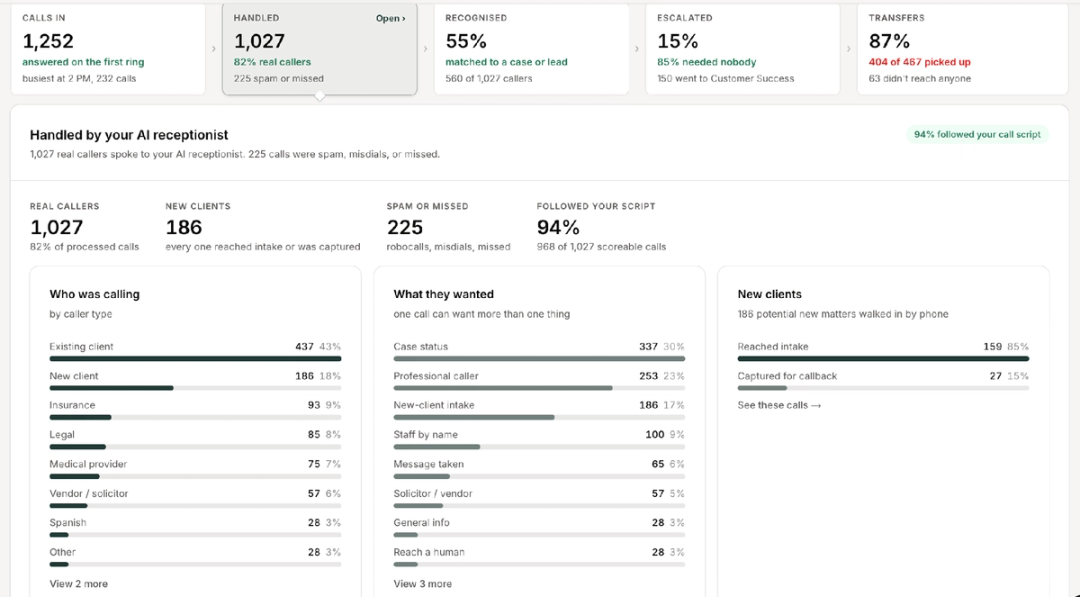
Caption: HelloCounsel dashboard (demo mode): one week of calls split by caller type and reason, with new-client calls tracked to intake or callback.
What changes for your team
- Faster speed to answer: Calls are picked up immediately, including nights, weekends, and campaign spikes
- Shorter intake: Qualification happens during the call, and intake notes reach the file without re-entry
- Automated check-ins: Treatment and status calls run on schedule, which keeps client communication current without a case manager dialing each one
- Workflows carried through: Agents work inside your existing case management system and finish supported tasks
- Lower overhead: Routine calls stop pulling paralegals and case managers off case work, which is the most direct way to reduce case manager workload
"Working with HelloCounsel has been an outstanding experience. Their commitment to client service and innovation is evident in everything they do. We've been extremely impressed with our new AI receptionist, Kate, and the impact it's already making for our firm. I'm excited to continue exploring additional solutions that allow our case managers to focus more time on delivering exceptional client care." Anthony Ramos, COO, Pendergast Law
What Nexa Offers Law Firms
Nexa is a virtual receptionist and call-center provider that serves law firms alongside home services, healthcare, and other industries. Its receptionists handle answering, intake, scheduling, live chat, text messaging, and outbound sales, in English and Spanish, around the clock.
Live receptionists across phone, chat, and text
Nexa's strength is a staffed front desk on more than one channel. Its terms and conditions also let Nexa use conversational AI agents on calls, texts, and chats, with a written opt-out for clients who want people only. Firms that want a human voice on sensitive first calls can get the same result with HelloCounsel by routing those callers to their own staff.
Did You Know
About 44.9 million people aged five and older speak Spanish at home in the United States, per the 2024 American Community Survey. Both vendors cover Spanish, and HelloCounsel handles callers who switch languages mid-call without a transfer.
What Nexa users report
Reviews show the other side of HelloCounsel vs Nexa: the limits of a staffed, multi-industry model. A law firm reviewer on Lawyerist said the receptionists would "say my name wrong" and sometimes sounded confused during transfers.
A reviewer on ConsumerAffairs reported receptionists "transferring phone calls before qualifying the customer." Script drift like this is hardest to control when one team answers for many industries, and it is where an agent that follows your SOP on every call holds up better.
Outbound Calls: Sales Campaigns vs PI Case Work
Both vendors dial out, so the HelloCounsel vs Nexa outbound question is what work each call completes. Nexa lists lead follow-up, appointment reminders, and outbound sales. HelloCounsel places the calls that move a PI case after signing, which is where AI on medical provider calls saves the most staff time.
| Outbound workflow | HelloCounsel | Nexa |
|---|---|---|
| Lead follow-up | Yes. Calls back new leads and logs each attempt | Yes. Lead follow-up calls |
| Appointment reminders | Yes. Confirms and reschedules within your workflow | Yes. Appointment reminders |
| Client status updates | Yes. Scheduled status calls and monthly check-ins | Not listed |
| Provider records status | Yes. Calls the provider and confirms the request | Not listed |
| Repeated records attempts | Yes. Keeps calling until the records arrive | Not listed |
| Treatment check-ins | Yes. Calls the client after each treatment visit | Not listed |
| Insurance claim opening | Yes. Opens the claim with the carrier | Not listed |
Firms running automated outbound voice calls should also review consent rules. The FCC ruled in February 2024 that AI-generated voices count as artificial voices under the Telephone Consumer Protection Act, so review consent requirements with counsel before launching outbound campaigns.
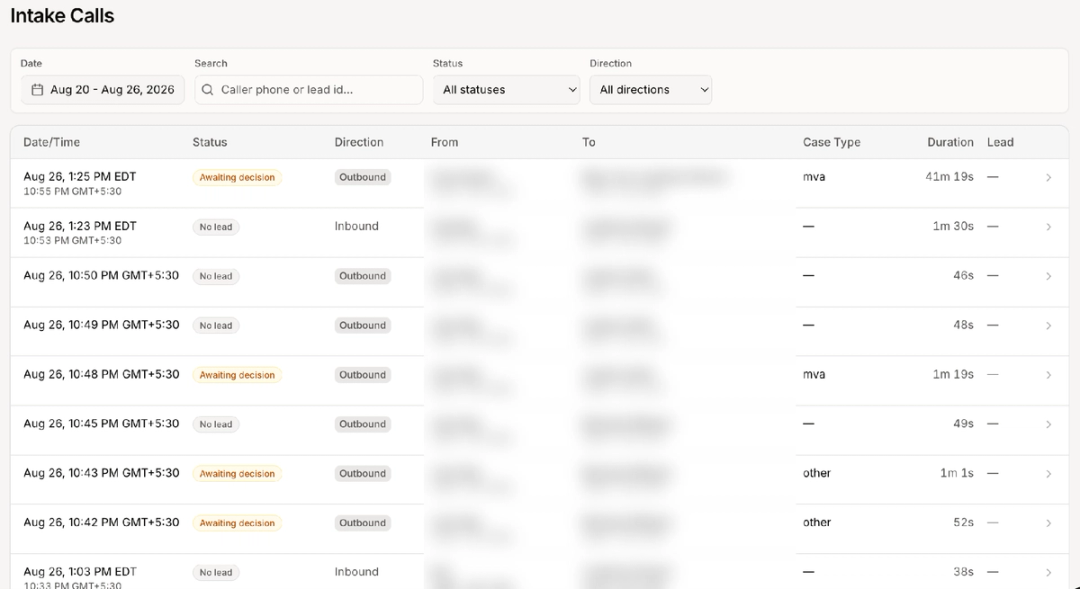
Caption: HelloCounsel intake log (demo mode, caller details blurred): inbound and outbound calls tracked by status and case type.
Integrations: What Lands in Your Case File
HelloCounsel writes call notes and outcomes directly into SmartAdvocate, Filevine, Litify, Lead Docket, and Clio. For case management systems outside that list, the team builds a custom integration scoped to your requirements and engagement size. Nexa connects to CRM and practice management tools, and Lawyerist lists Clio and Filevine among its legal integrations, with Zapier covering others.
In any HelloCounsel vs Nexa demo, ask each vendor to write a test call into the same matter type and fields your firm uses. Firm-specific options are covered in our guides for Filevine firms, Litify firms, and SmartAdvocate intake.
Alt text: HelloCounsel call log with callers tagged as client, new client, vendor, legal, insurance, and medical
Caption: HelloCounsel call log (demo mode): every call is tagged by caller type, so provider, insurer, and client calls are handled separately from new leads.
HelloCounsel vs Nexa Pricing
Pricing is the sharpest HelloCounsel vs Nexa contrast, because the two vendors meter work differently.
How Nexa bills
Nexa sells plans sized at 100, 300, and 500 voice minutes, with a setup fee and overage billed at your base rate. Its terms bill time in whole minutes and round partial minutes up. Billable time includes hold time before a transfer, outbound ringing, and work a receptionist does after the caller hangs up. Some plans bill per event instead, such as per call, chat, lead, or text.
For a PI firm, that means a TV campaign or mass tort docket that doubles call volume also raises the bill, and so does every minute a receptionist spends on after-call notes. The hidden cost of missed calls shifts into the cost of metered calls.
How HelloCounsel prices
HelloCounsel does not bill by the minute. It’s scoped to your call volume and licences. The price stays fixed within a 20 percent usage tolerance either way, there is no setup fee, and for SmartAdvocate deployments HelloCounsel covers SmartAdvocate's integration fee. Setup takes one one-hour configuration call.
| Pricing question | HelloCounsel | Nexa |
|---|---|---|
| Billed by the minute | No. Fixed monthly price from $500 per month | Yes. Whole-minute billing with partial minutes rounded up |
| Hold and after-call time billed | No. Priced on scoped volume, not talk time | Yes. Hold, outbound ringing, and after-call work count |
| Overage charges | No, within a 20 percent usage tolerance | Yes. Overage billed at your base rate |
| Setup fee | No. No setup fee | Yes. Covers programming, onboarding, and training |
| Published starting price | Yes. $500 per month | No. Plan sizes published, prices by quote |
Note
The median hourly wage for receptionists was $17.90 in May 2024, and employment is projected to show little or no change through 2034, per the US Bureau of Labor Statistics. Staffing reception in-house carries its own fixed cost, which is worth modeling beside both quotes.
Which One Should Your PI Firm Choose?
Your firm's bottleneck usually settles the HelloCounsel vs Nexa choice.
| If your firm needs | Choose | Why |
|---|---|---|
| Case managers freed from routine calls | HelloCounsel | Agents handle status, provider, and adjuster calls and write the result to the file |
| Records, treatment, and claim calls handled | HelloCounsel | Outbound case work is part of the core workflow |
| Caller and matter context before handling | HelloCounsel | Caller pre-identification routes by case phase |
| A fixed monthly cost that holds in busy months | HelloCounsel | Fixed price from $500 per month within a 20 percent tolerance |
| Measured call performance | HelloCounsel | Dashboard tracks volume, caller type, transfers, and script adherence |
| Live people on phone, chat, and text | Nexa | Staffed front desk across three channels |
For most mid-market PI firms, the HelloCounsel vs Nexa answer turns on the load after intake. If your front desk already answers every call and your case team is still buried in phone work, HelloCounsel is built for that gap. Compare it with other AI voice agents for personal injury firms or legal answering services for personal injury firms using the questions below.
Seven Questions to Ask Any Legal Answering Service or AI Voice Agent
Use these questions in every demo, and pair them with our guide on how to evaluate an AI voice agent.
1. What happens after the call is answered? Ask whether the vendor takes a message, transfers, completes a task, or updates the matter
2. How does it know who is calling? A prospect, client, provider, and adjuster each need a different flow
3. What outbound work can it own? Separate reminders and sales calls from records, treatment, and claim calls
4. What gets written into the case file? Ask for a real note, field update, or transcript and where it appears
5. Does follow-up continue after the first attempt? Records requests often take several calls
6. How does the bill change when volume spikes? Model minutes, rounding, hold time, and overages against a busy month
7. Which calls still go to a person? Ask to see the escalation rules for sensitive and judgment-heavy calls
Whichever vendor you pick, professional duties stay with the firm. ABA Formal Opinion 512 confirms that competence, confidentiality, and supervision duties apply when lawyers use AI, and call recording rules vary by state.
Choose the Model That Removes the Work Your Team Still Does
The HelloCounsel vs Nexa decision gets simpler once you map your calls. Choose Nexa if you want live receptionists across phone, chat, and text, and your team has room for the follow-up each call creates. Choose HelloCounsel if your plaintiff firm wants every call answered, every supported task finished, and every outcome written into your case management system, starting at $500 per month. Slow callbacks are a common reason firms lose cases before signing, and routine case calls are what bury the team after signing. Review the HelloCounsel product against your own call types.
Book a workflow review with the HelloCounsel founders and bring one week of call categories. The team will show you which calls the agents can take over and how each result lands in your case file.
Frequently Asked Questions
Is HelloCounsel a Nexa alternative for personal injury firms?
Yes. HelloCounsel answers every call, handles intake, runs outbound records, treatment, and claim calls, and writes outcomes into the case file. Nexa provides live receptionists across phone, chat, and text for many industries.
Does HelloCounsel handle inbound and outbound follow-up calls?
Yes. HelloCounsel answers inbound calls and places outbound follow-ups for leads, provider records, treatment check-ins, and insurance claims. It keeps calling until each task closes and logs every attempt to the case file.
Which is better for after-hours legal intake?
HelloCounsel qualifies after-hours callers against your criteria in seconds and writes intake notes straight to your case management system. Nexa covers after-hours intake with live receptionists.
Does Nexa use AI or only human receptionists?
Nexa uses live virtual receptionists, and its terms allow conversational AI agents on calls, texts, and chats. Clients can opt out of AI in writing.
Which is better for medical records retrieval?
HelloCounsel runs medical records retrieval as a core workflow, calling providers, waiting on hold, and following up until records arrive. Nexa does not list a PI records workflow.
How does HelloCounsel pricing compare with Nexa?
HelloCounsel starts at $500 per month with fixed pricing and no setup fee. Nexa bills receptionist work time in whole minutes, including hold and after-call time, plus a setup fee and overages.
Which case management systems does HelloCounsel integrate with?
HelloCounsel writes directly into SmartAdvocate, Filevine, Litify, Lead Docket, and Clio, and builds custom integrations for other case management systems based on firm requirements.
Share this article